Solomon Burke and Erin...


Soul is the deep feeling that is expressed from the heart and the mind: from a musician, an artist, a dancer, a photographer or from a writer. When your open your heart and pour out your spirit, and you feel something that makes a difference in your life: that is the meaning of soul.

               Solomon Burke

I think I met Elvis two times. The first time I met him was a very brief situation in Tennessee. He remarked about my singing. He liked my singing and my style of singing and things like that. I said 'Hey man, we all love what you're doing. You're doing it baby.' It was that type of situation. And the next time he asked me about my gold suit. I had a gold suit that I wore. He asked me where I got it and I told him. Next thing I know, Elvis had his own gold suit. When I went back to my tailor to get another gold suit made, which I was only paying $450 for, which was big money in those days, my tailor said "Oh no man, I make suits for Elvis now. Those suits are $900." I can't believe you man. I'm the guy who started it. But, that's the way life is, man.

               Solomon Burke on Elvis Presley

I was here in Los Angeles, visiting Sam. That evening, we ate at a local restaurant. Afterwards, I went back to the hotel he'd booked for me. There I got a call saying he was dead. I said, 'That can't be. I was with him an hour ago.' That same day, Delores (wife number two) had told me that she wanted a divorce. I sat down and started to write '"Got To Get You Off My MInd." I never want to go through anything like that again.

               Solomon Burke on visiting with Sam Cooke, December 11, 1964

IMG_0740.png

From The Heart (1981) signed by Solomon Burke

During that period a man by the name of Andy Kaulkin was watching that show that Saturday and he stayed over Sunday to see what would happen. He came over to us and my daughter said 'Dad, this guy is trying to talk to you. He's with Fat Possum or something', and I said 'Oh God, I hope it's not one of those football teams'. They had asked me to be a mascot and a sponsor for a group called the Big Bears earlier. Can you imagine me in a big bear costume? I said 'I'll give money, but I'm not gonna put the costume on to be a mascot. You have to get another guy running out as a Fat Possum'. I didn't ignore him, but kinda tried to get away from him. How lucky for myself that we met at the airport at the same time catching the same plane, and he was sitting right behind me....That’s the beginning of that story. We hit it off, had lunch, and made a record. It was one of the greatest moments in my career and the first record company that was ever sincere and dedicated and real; it has left an everlasting memory in my mind. We had a two-page contract; they lived up to every word of that contract and they did everything they possibly could for that record to bring it home and they gave me my first Grammy. But they gave me great songs—Elvis Costello, Van Morrison, come on, that was an incredible CD.

               Solomon Burke on signing with Fat Possum and recording Don't Give Up On Me

IMG_0739.png

Don’t Give Up On Me (2002) signed by Solomon Burke

I remember being in the studio, recording that album. I'd told everybody I'd allow no smoking or drinking. The studio is a holy place when I am recording. There are candles. There are flowers. My throne is there. Visible. That is where I record from. God has set me down. It was time to do "The Judgment." I hadn't rehearsed these songs, I did them as they were handed to me. I heard people shouting, 'Elvis is here! Elvis is here!' At first, I thought they must be smoking crack. Anyhow, Costello came in and told me he wanted to hear me sing the song. I said, 'Hear It? You're going to teach it to me.' When he sang it, it was just wonderful. I said, 'Right, OK, let's record that right now.' What people fail to realize is that a great song has no color. That's a beautiful song that he wrote.

               Solomon Burke recording "The Judgment", Don't Give Up On Me 2002

I'd sit with Don Covay writing those songs and just cry. I'd say, 'Don, you have such a beautiful wife, but mine is probably out somewhere slashing my tires because I was off with some chick.' I was a young man, girls were coming from every angle. I couldn't love 'em all, but I certainly tried.

               Solomon Burke

IMG_0741.png

A Change Is Gonna Come (1986) signed by Solomon Burke

Father of twenty-one children, Grandfather to ninety, Solomon Burke, "The King of Rock 'n' Soul", lived life large. It was said that his favorite scripture was "Be fruitful and multiply" to which he readily ascribed, admitting "I got stuck on that verse." Born in West Philadelphia, Solomon started in the church when he was only seven years old, testifyin' and proselytizin'. He was dubbed "The Boy Wonder Preacher" for his magnetic and engaging sermons, and by the time he was twelve, Solomon was preaching on the radio and traveling to cities, performing in tent revivals carrying his Gospel message. Joel Osteen clearly had nothing on him! His Grandmother, Eleanor Moore, a seer and spiritualist, ran a church out of her home, The United House Of Prayer For All People. It was a ripe and fertile music environment that affected Solomon deeply, "Every day they had a service, and the music never stopped. There was always a band with two or three trombones, tubas, tambourines, cymbals, guitars, pianos. When I speak of the music, I get choked up. It was a message to God, something you feel down to your bones and your soul and your heart." Grandmother Eleanor also foretold Solomon's prominence: "She predicted my career, the size of my family, the people I would meet, how I’d travel. She told me so often that I thought I would have to be Superman to do it all.”

Indeed, Solomon Burke was a super man who lived a remarkable life. Solomon wrote his first song as a tribute to his Grandmother when he was fourteen. "God gave me the song on December 10, I finished the song on December 17, and on the 18th she said that she wanted to speak to me. She said, 'I want you to see your Christmas present.' And I said, 'Now?' She said, 'Yes, look under my bed.' And I looked under her bed, and there was a guitar wrapped in a pillow case. And then I sang my little song that I had written for her, called 'Christmas Presents From Heaven', not knowing that it was a prophecy for me, to alert me to the future. Then on the morning of the 19th my grandmother passed in her sleep, so she only heard the song one day - but that whole day she was briefing me and telling me the different things that were going to happen and all the children that I would have, the loves in my life, just laying it out: 'You'll have big homes, fancy cars' - but I'll never forget the most exciting thing she said to me, and then the most depressing thing, too. The most exciting thing was that I would be able to reach out and touch people and help them spiritually, thousands of people, millions of people, and then she said to me that I would go down to the pits of Hell and submerge at will, and I've been there a couple of times... I've been there you know."

Whatever fantastical vision Grandmother Eleanor had for Solomon pales in comparison to what actually transpired, as his descent came almost as rapidly as his ascent. Solomon signed with Apollo Records as a fifteen year old, wrote and released nine singles with limited success, but scored a hit with "You Can Run, But You Can't Hide", a riff on retired Heavyweight Boxing Champ Joe Louis' mantra, "He can run, but he can't hide."  Joe Louis' wife smartly held a trademark and she insisted that Solomon give a co-writer credit to her husband. Solomon acquiesced and he ended up touring with Joe for nearly a year which culminated with an appearance on the Steve Allen Show in 1957, heady national television exposure for a seventeen year old! Years later, Solomon remembered the circumstances, "Joe Louis was supposed to introduce me. Steve Allen said to Joe, 'And who did you bring with you tonight as a special guest?' And Joe Louis couldn't remember my name, but he remembered the song, of course. And at the same time, Dick Haymes had covered this record.....so he said 'Dick Haymes.'  The record company people must've had a heart attack! It was so funny. Joe was such a wonderful person. His personality and charm was unbelievable...It was a year that I will always remember, It was a very beautiful year."

Shortly thereafter, Solomon got into a violent argument with his manager over royalties and he was dropped from Apollo Records rather abruptly. The next few years were difficult as Solomon endured homelessness when his parents kicked him out of their house for his worship of "the devil's music." Estranged from his church and family, Solomon lived in abandoned cars, "There was no place I could turn. I was shamed. I was a bum." It got worse. Leaving a club, Solomon was hit by a car and the driver, Othella Thompson, the wife of a dentist, took him home and helped nurse him back to health. Solomon ended up marrying her niece, Delores, and before resuming his singing career, he became an apprentice mortician, learning a valuable trade. As he said, "I loved the work. At a moment when there is no hope for the family, a mortician can give them hope." Later, Solomon opened a string of funeral homes in Los Angeles and his daughter, Victoria ran a lucrative business. As fellow soul singer Joe Tex wryly observed, "Solomon Burke knock you dead from the bandstand. Then he gift wrap you for the trip home."

In November 1960, Solomon re-entered the music business, joined Atlantic Records and the hits soon followed. His second single, "Just Out Of Reach (Of My Two Open Arms)", a Patsy Cline cover, was his first million seller. If Atlantic Records was "The House That Ruth (Brown) Built" in the early 1950s, Solomon certainly did his part to keep it afloat in the early 1960s, especially since Ray Charles and Bobby Darin had recently departed the label. "If You Need Me", "Cry To Me", "Everybody Needs Somebody To Love", "Tonight's The Night", and his only number one hit  "Got To Get You Off My Mind" made Atlantic Records millions. Like many artists, Solomon gave away some of his publishing to his producers. Unseemly, unscrupulous and unfortunately, not an uncommon industry practice, Solomon explained, "That's how they got a piece of the song. They didn't write a word. In those days, it didn't make any difference. You wanted to get your product out....We didn't know what publishing was. We thought we had to give our publishing to the record company so the record could get out."

IMG_0743.png

Back To My Roots (1976) signed by King Solomon Burke

Solomon's rewriting of a country song in the public domain, "Down In The Valley" yielded an unlikely hit and an even more unlikely fan base. He got mistakenly booked at a Ku Klux Klan rally in Mississippi with 30,000 wrong-minded attendees. "My drummer was saying to me, 'Will we ever get out of here alive?' I said, 'Just keep playing until they say we're done.' I think we played 'Down In The Valley' for forty-five minutes." After the show, a police escort spirited them to the highway out of town. Solomon's music cut across blues, country, gospel, rock and soul, but that cross over was almost too much.

Solomon's career ebbed in the 1970s as music tastes changed and disco music became prevalent. Then, The Blues Brothers movie came out in 1980. It featured Wilson Pickett singing "Everybody Needs Somebody To Love." At the end of the film, the credits scrolled and Solomon was shocked to see his producer Jerry Wexler and Wilson Pickett listed as the songwriters. Solomon's attorneys threatened an injunction to stop the hit movie. As Solomon related, "We started calling and the producers said, 'We thought Solomon died.' Well, he has risen....and he would like a check!" A check for $20,000 from Atlantic Records showed up the next day. To that end, Solomon became very protective of his copyrights as a result or his early mistreatment, however, he did license "Cry To Me" in the Dirty Dancing movie in 1987. With all due respect to Baby, nobody puts Solomon in the corner!

IMG_0736.jpeg

King Solomon testfyin’ BB Kings, March 4, 2005

Erin and I went to see Solomon perform at BB King's Club in New York City on March 4, 2005. As a special treat, our great friends from Washington, DC, Danny and Karen Callahan joined us at a nice red leather banquette about fifteen feet from the stage. The curtain was closed on stage as we enjoyed some pre-show libations. Just then, the house lights dimmed, and the curtain slid open to reveal the mighty King Solomon in all his splendor and munificence, perched on a throne. He was regal and stately, even though he remained seated for the duration of the show. And what a show! Fueled by a twelve piece band which included his daughter Candy on back up vocals, Solomon launched into his hits, "Cry To Me", "If You Need Me", "Down In The Valley", a beautiful soul meets country take on Eddy Arnold's "I Really Don't Want To Know", and the sublime gospel of "A Change Is Gonna Come" from the pen of his friend Sam Cooke. Then, Solomon spent time talking about how lucky he was to meet Joe Henry, the producer of his (first!) 2003 Grammy award winning album, Don't Give Up On Me. Joe had requested that some of his favorite songwriters contribute tracks that Solomon might record, and Bob Dylan, Elvis Costello, Van Morrison, Tom Waits, and Brian Wilson all responded. With his deep, buttery baritone, Solomon transformed these songs into his own. They were equal parts soul shoutin' and soul testifyin', the profane never straying too far from the sacred.

IMG_0737.jpeg

Solomon Burke handing out roses, BB Kings, March 4, 2005

For his encore, Solomon invited all the ladies on stage to join him on "Everybody Wants Somebody To Love." Even in his sixties and confined to a wheelchair, his unerring eye and appetite for the ladies remained intact. Of course, Erin and Karen bounded up on stage and sang back up with a bevy of other beauties. The chorus never sounded better. After the show ended, the curtain closed and Solomon was whisked by wheelchair to his dressing room. Erin followed in hot pursuit with some vinyl.

Here's what she told me:

She followed Solomon into his dressing room with the albums, and he received her with a warm bear hug and a solicitation to sit on his lap while they looked at the albums. Erin declined his gracious invitation and told him what a terrific show he had just performed. He again requested that she sit on his lap, tapping on his thigh. She laughed and wisely handed him the albums, placing them in his lap. Then, Solomon signed the albums with beautiful inscriptions, "You are the best, May God's blessings be yours",  "You are God's blessed" and "To Erin, Love & God's blessings." While others were now in the dressing room, including his daughter, and other back up singers, Solomon was still trying to get a lap dance. Even off stage, the sacred Solomon never strayed far from the profane. Erin thanked Solomon for the show, grabbed the vinyl and left. Without a lap dance!

Solomon Burke, business man, ladies man, minister, mortician, singer, songwriter, soul shouter. As producer and "co-writer" Jerry Wexler described him, "A piece of work, wily, highly intelligent, a salesman of epic proportions...the best soul singer of all time." 

Amen. Long live the reign of King Solomon!

IMG_0738.jpeg

King Solomon and friends, BB Kings March 4, 2005

Choice Solomon Burke Cuts (per BK's request!)

https://www.youtube.com/watch?v=qU5Ny7mF_1g

"Cry To Me"   Live 2002

https://www.youtube.com/watch?v=Vy7lsju3RmA

"Cry To Me"  original 1962  re-released 1987  Dirty Dancing

https://www.youtube.com/watch?v=LJylh19OfCg

"That's How I Got To Memphis"  Live 2005 with Buddy Miller

https://www.youtube.com/watch?v=u2OgM6CflF8

"Diamond In Your Mind"  Solomon sings Tom Waits   2002

https://www.youtube.com/watch?v=W0bsWl-GnOo

"Don't Give Up On Me"  Live....truth, respect, words

https://www.youtube.com/watch?v=FDtCOvAEpUM

"Everybody Needs Someone To Love" Live with The Rolling Stones  2002

https://www.youtube.com/watch?v=ZW4jyPxqFY0

"Everybody Needs Someone To Love"  Live 1987

https://www.youtube.com/watch?v=GimsDeBWTSs

"Down In The Valley"  Live  2005

https://www.youtube.com/watch?v=h4lciVIIO4s

"Got To Get You Off My Mind"  1965 #1 Single

Lou Reed and Me...

My God is rock 'n' roll. It’s an obscure power that can change your life. The most important part of my religion is to play guitar.

               Lou Reed

IMG_0626.png

Transformer (1972) signed by Lou Reed

What I wanted to do [was] write rock & roll that you could listen to as you got older, and it wouldn't lose anything. It would be timeless, and the subject matter and the literacy of the lyrics.


               Lou Reed

The Velvet Underground (1967) signed by Lou Reed

Lou Reed, an influential rock icon, began his career as a member of the Velvet Underground, a semial New York City rock band in 1965. Brian Eno, the acclaimed producer and recording artist, once quipped, "They only sold 30,000 copies (of their first album) in the first five years, but everyone who bought one started a band." Lou was the principal lyricist for the band, using writing skills he honed as an honors graduate with an English degree from Syracuse University in 1964.

Berlin (1973) signed by Lou Reed

 Lou's writing was spare and graphic. His biggest Top 40 hit, "Walk On The Wild Side" released in 1972, was a bleak description of hookers, transgenders, and male prostitutes in a gritty urban landscape, not the usual Top 40 lyrics then or now. Featuring saxophone and upright bass, it was an unusual sonic departure with jazz overtones, David Bowie said upon listening, "I had never heard anything quite like it. It was a revelation to me."

Rock n Roll Animal (1974) signed by Lou Reed

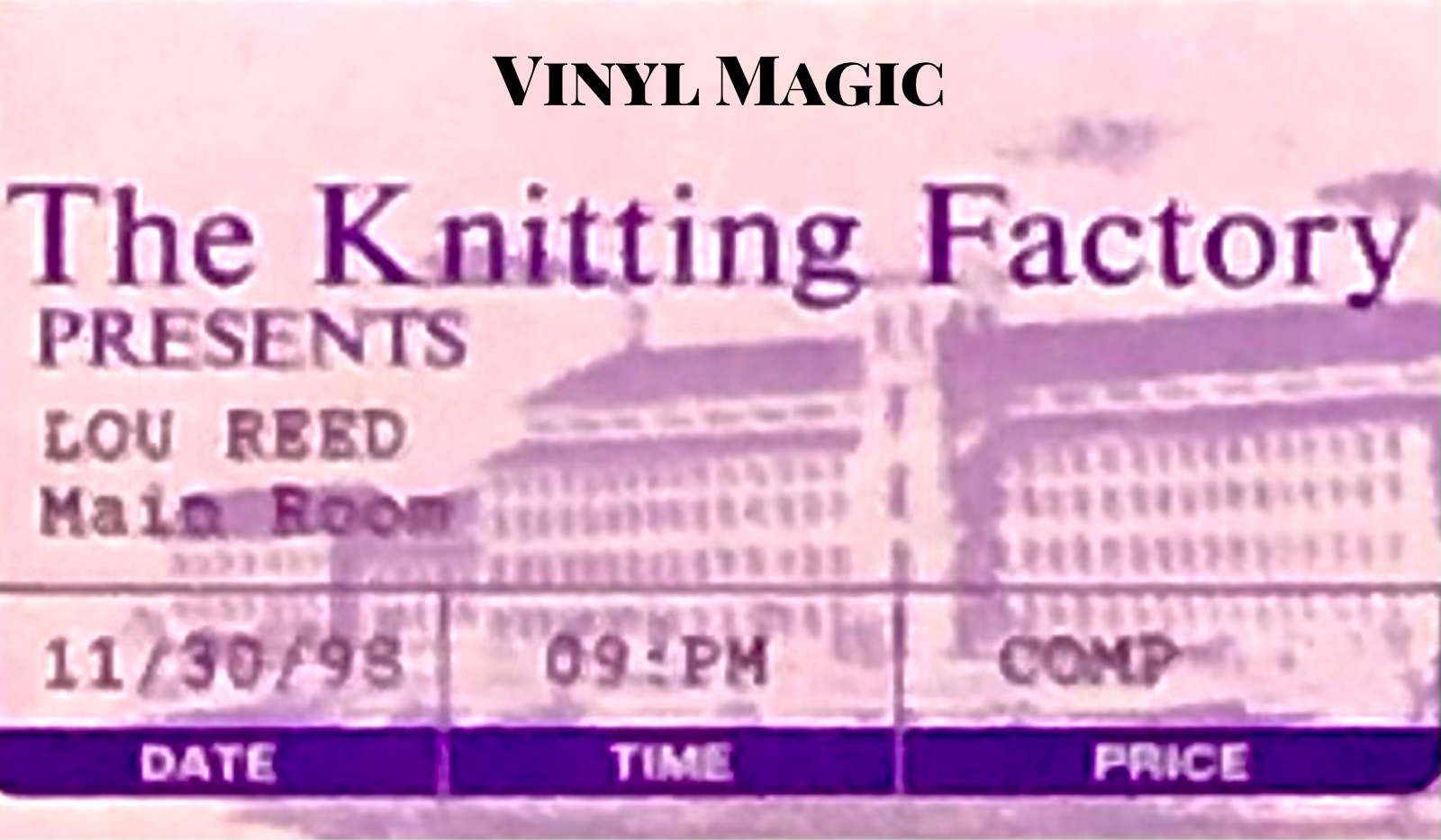
I saw Lou many times over the years, the last time at the Knitting Factory on November 30, 1998. A downtown New York City club, the Knitting Factory featured an interesting mix of avant garde jazz and rock and roll. Diverse artists like Pharoah Sanders, Cecil Taylor, Charles Lloyd, and David Byrne were some of the shows I saw there. It was small and intimate with a capacity around three-hundred including a small upstairs balcony.

 Lou always put on a good show, especially in New York. He was clean and sober since the 1980s and a long way from the wreck he was in the 1970s. I remember an old college friend saw him in Boston in the late 1970s and he told me that Lou was a mess. Lou had just released Metal Machine Music, an unlistenable suite of industrial noise (on two LPs of course!) and he performed it exclusively at this show. The music was grating, but my friend really enjoyed the show from a sociological viewpoint. Lou was being heckled mercilessly by fans who wanted to hear his hits, but Lou didn't care. He was strung out, and he was alternately nodding and combative, a memorable and combustible performance.

New York (1989) signed by Lou Reed

 After a crisp and loud Knitting Factory show, I went upstairs to the dressing rooms to see Lou. There was a line of folks with backstage passes waiting. When the door opened, I slid in with the small group of close friends and family and entered. There were a couple of couches in the dressing room where Laurie Andersen (Lou's wife and noted performance artist) was sitting. I saw Lou and asked him to sign a couple albums. He looked at me warily. I sensed his suspicion, so I said, ‘Hey Lou, my brother-in-law just saw you perform at the White House for Vaclav Havel (the recently elected President of Czech Republic and huge Velvet Ungerground fan). He said it was surreal. What did you think? ‘ After a long, uncomfortable pause, Lou replied, "It was........surreal." He quickly signed the albums, then he looked past me, "Bill? Where's Bill? Has anyone seen Bill?"

That was my cue. Bill was his tour manager and Lou didn't want to spend any more time talking to me. I was an intruder and it was time to leave. So I left. Thereafter, whenever boundaries blur, I act creepy or stalk some other artist, one of my closest friends pulls me back with this unsubtle reminder: "Bill? Where's Bill? Has anyone seen Bill?"

Hope our paths cross soon.

IMG_0630.png

New Sensations (1984) signed by Lou Reed

Choice Lou Reed Cuts (per BKs request)

https://www.youtube.com/watch?v=7FdWPeHFAMk

“Sweet Jane” Rock N Roll Animal 1974

https://www.youtube.com/watch?v=oG6fayQBm9w

“Walk On The Wild Side” Transformer 1972

https://www.youtube.com/watch?v=1SHCsgqZvQM

“Coney Island Baby” Coney Island Baby 1975

https://www.youtube.com/watch?v=Wo9nZEalABQ

“Berlin” Berlin 1973

https://www.youtube.com/watch?v=TWFgGxe-CjI

“Pale Blue Eyes” live 1998

https://www.youtube.com/watch?v=uCpkwAkNJj0

“Perfect Day” live at The BBC 2003

https://www.youtube.com/watch?v=RQsJK0voNRI

“September Song” Lost In The Stars 1985

https://www.youtube.com/watch?v=G7Ch4O7wmuY

“Heroin” Rock N Roll Animal 1974

https://www.youtube.com/watch?v=ZH96BsL1R3U

“Dirty Blvd.” New York 1989

https://www.youtube.com/watch?v=W4VEXl4vsq4

“Waiting For The Man” live with David Bowie 1997

Mitchell-Ruff and Me...

I learned long ago that it does no good to complain about the piano. Once you start complaining, you’re throwing yourself into another state. You think, ‘This damn piano,’ and you get mad at it, and when you get angry, you play angry and you can’t project who you really are, because you’ve been transformed into an angry person and all kinds of things are going through your mind. Instead you say, ‘What does it do? Will it do anything? Let’s check it out.’ You try to work with it, and sometimes it’s a lot of fun, because many pianos give you a different response from the one you’re used to, and that makes you play differently.

Dwike Mitchell

IMG_4247.png

After This Message (1966) signed by Mitchell Ruff

I write this years later, remembering it as if I had just stepped out of Strayhorn's apartment or slipped into the wings at Lincoln Center, with Ellington's voice shivering me in the heart. It was indeed a landmark, a transition for a still young artist who had come from what seemed like nowhere, had arrived somewhere, and was going he knew not where. The one thing I do know about that magical evening—about the totality of that experience with those creators and ambassadors of the music that was born and bred nowhere else but in America—is that it seemed to me a calling: a "call to assembly" was the phrase they used when I was a young army private. I knew I was on notice, and I had to heed the call.

A Call To Assembly (1991) by Willie Ruff

IMG_4261.png

Appearing Nightly (1957) signed by Mitchell Ruff

Dwike Mitchell and Willie Ruff formed the Mitchell Ruff Duo in 1955 after playing rhythm in the Lionel Hampton orchestra in the early 1950s. They were small town Southern boys, Dwike from Alabama, Willie from Florida, who met in the US Army in 1947 and bonded over their passion and love of music. Mitchell Ruff became an acclaimed jazz duo and they were the first jazz band to play in the Soviet Union in 1959, playing at conservatories in Leningrad, Kiev and Moscow, and in China at conservatories in Peking and Shanghai in 1981. They were wildly received and celebrated.

They were an unlikely pairing. Willie Ruff is as outgoing and effusive as Dwike Mitchell is shy and reclusive. Both are classically trained virtuoso musicians, Dwike the florid pianist with tremendous technique, Willie the kinetic upright bassist and purveyor of exquisite French Horn. Mitchell Ruff opened for all the major bands in the 1950s, including Louis Armstrong, Duke Ellington, Count Basie and Dizzy Gillespie, and they released some glorious recordings.


Dwike Mitchell is simply the greatest jazz pianist that most people have never heard. Don't take my word, ask Duke Ellington or Billy Strayhorn. Strayhorn was Duke's arranger, right hand man for nearly thirty years and the brilliant composer of "Chelsea Bridge", "Lush Life", and the Ellington theme, "Take The A Train." Billy and the Duke had become staunch fans of Mitchell Ruff and would see them perform regularly at the Hickory House in New York City. As Strayhorn was dying of cancer, he  wrote a piece for Mitchell Ruff, "Suite For Piano And Horn", which appears on Strayhorn: A Mitchell Ruff Interpretation (1972) and features other classic Strayhorn songs. This is one of the few compositions Billy wrote for anyone other than Duke Ellington. When Billy died in 1968, Ellington curated and stage managed his memorial (which established a scholarship at Julliard), and Mitchell Ruff played "Suite For Piano And Horn." As Duke told Ruff when they finished, "Strayhorn smiled tonight." Fitting praise and an august honor from the highest music royalty.

IMG_4248.png

Strayhorn: A Mitchell Ruff Interpretation (1972) signed by Mitchell Ruff

In 1971, Willie Ruff joined the Yale School Of Music  and he has had an esteemed career in academia, culminating in receiving Yale's highest award in 2013, The Sanford Medal. As a result of Willie's academic responsibilities, Mitchell Ruff club performances were rare. Erin and I were lucky to see them twice, once at the Duke Ellington School Of The Arts in Washington, DC for a Jazz Freedom Concert in 1987, and at the Yale Summer School Of Music in Norfolk, Connecticut in 2003. Two very memorable performances.

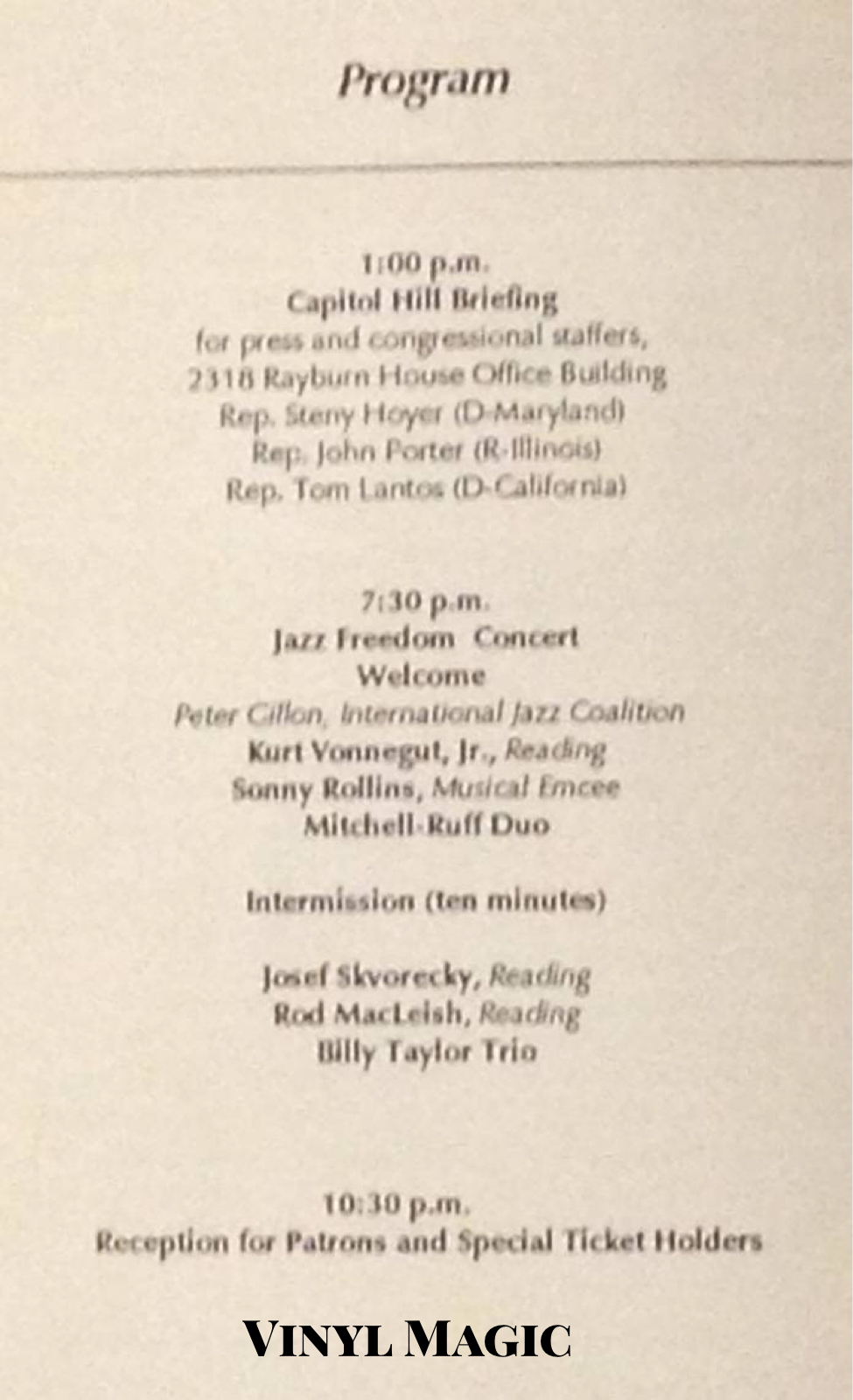
The Jazz Freedom Concert was a fundraiser to create awareness for the plight of Czechoslovakia's Jazz Section, jazz enthusiasts who promoted jazz through magazines and concerts since the 1968 Soviet Union invasion.This organization was abolished in 1984 (with an apparent nod to George Orwell) and two of its leaders were given 16 month prison sentences in 1987 for "illegal economic activities." Sonny Rollins (sans saxophone) served as MC, author Kurt Vonnegut and noted Czech author Josef Skvorecky gave readings, and the Mitchell Ruff Duo and The Billy Taylor Trio delivered sparkling sets. The concert was broadcast live over Voice Of America to Eastern Bloc countries. Perhaps it really wasn't President Reagan imploring, "Mr. Gorbachev, tear down this wall" that caused the Cold War to end...

IMG_4252.png

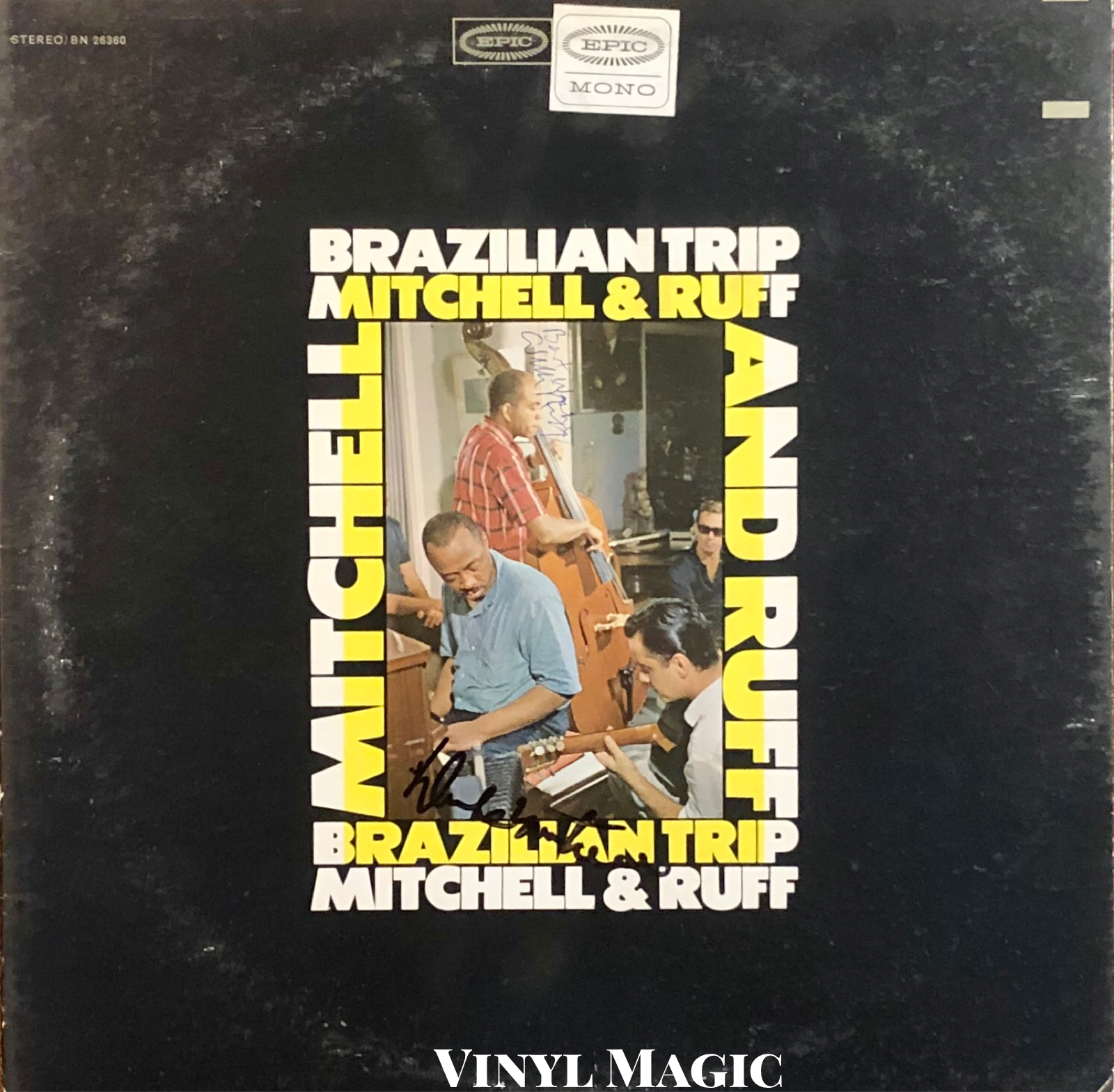
Brazilian Trip (1966) signed by Mitchell Ruff

After the concert, there was a small reception for the artists. I made a beeline to Willie Ruff with some albums. I told him Brazilian Trip (1966) was one of my favorites. He laughed, "Tanto Canto, that's a great song." I agreed, it is the first song and it has a beautiful and intricate French Horn solo. Brazilian Trip is brilliant and it is my favorite bossa nova jazz album by far. Stan Getz and Charlie Byrd's Jazz Samba (1962) is close, and there are some great recordings by Jobim, Gilberto, and Bonfa, but this virtually unknown album, recorded in Brazil with some (then) unheralded performers and their original compositions is stunningly beautiful. Its neglect is criminal. I asked Willie when he was finished signing where Dwike was. "Oh Dwike's already left. He doesn't really do these things."

IMG_4250.png

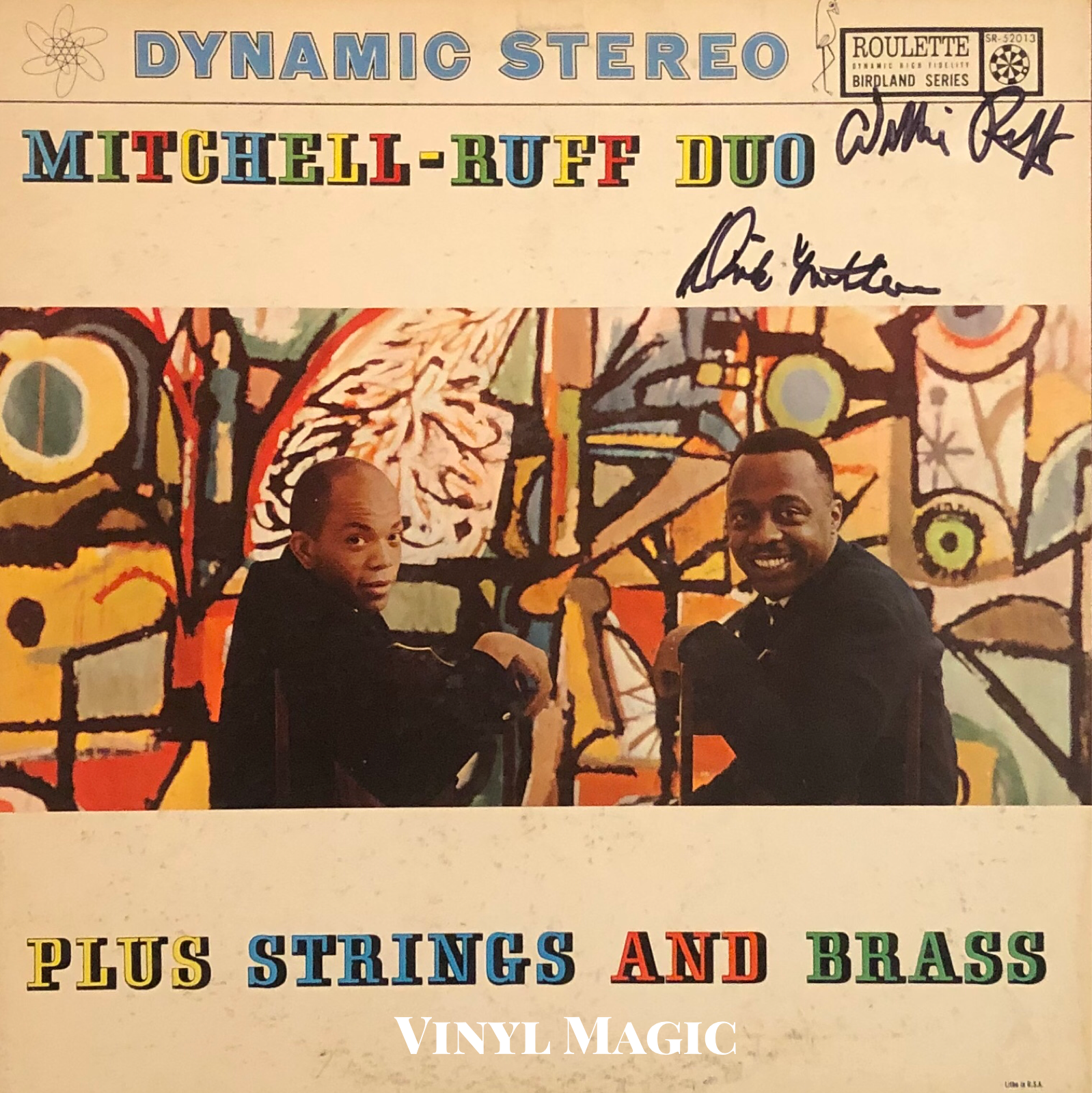
Plus Strings And Brass (1958) signed by Mitchell Ruff

Sixteen years later, we saw Mitchell Ruff perform at the Music Shed on the beautiful Stoeckel estate in Norfolk, Connecticut. This estate was bequeathed in 1939 to Yale University by Ellen Battell Stoeckel, the daughter of wealthy industrialist and philanthropist, Robbins Battell. The Music Shed was built in 1906, seats 1500, and is constructed with cedar and redwood imported from California (apparently you could cut down Redwood trees in the early 1900s). As beautiful as it is, the Music Shed acoustics are equally extraordinary, and many artists have performed on this stage throughout its illustrious history including Enrico Caruso, Sergei Rachmaninoff, Jean Sibelius and Dave Brubeck.

The Mitchell Ruff show was exceptional.  Willie, a gifted speaker and educator, introduced each song and gave some needed back story. Dwike Mitchell did all his talking through his playing. They played "Autumn Leaves", Willie dropping the bottom with a beautiful bass solo introduction and setting the groove, then Dwike coming in with quicksilver runs on this familiar melody, darting in and out, his phrasing alternately loud and delicate. I never saw Art Tatum, but I have seen Dave Brubeck, Oscar Peterson, Hank Jones, Chucho Valdes, Brad Mehldau and so many others. No one comes close to Dwike's piano artistry. No one.

They played the blues - "The Catbird Seat", a filthy funk redolent of a 4am vibe, standards - a rollicking "They Can't Take That Away From Me" from the Gershwin catalog, and classical - Stravinsky's "Firebird Suite" complete with Ruff's extended French Horn solo and introduction, followed by the magnificent comping of Dwike Mitchell. And don't get me started on their sublime version of Brahms "Lullaby"... It was a thorough and complete musical education in ninety minutes.

IMG_4251.png

The Catbird Seat (1961) signed by Mitchell Ruff

After the show, I headed backstage. Willie was holding court, surrounded by many well wishers. I looked around for Dwike. No sign of him. I asked Willie. "Oh, he's back there, hiding out." I was determined not to lose my quarry again so I went back-backstage. There was Dwike by himself. I thanked him for his performance and especially his remarkable piano prowess. I told him how beautiful and meaningful his music is. He signed the albums, thanked me and I left.

Mitchell Ruff performed for nearly 60 years together (until Dwike passed in 2013), as Willie noted, "the oldest continuous group in  jazz without personnel changes." They were ambassadors and statesman who traveled the world delivering beautiful music to educate and enrich the lives of so many.

They definitely enrich mine.

IMG_4249.png

Dizzy Gillespie Live (1981) signed by Mitchell Ruff

IMG_0613.png

Jazz Freedom Concert (1987) signed by Kurt Vonnegut

IMG_0612.png

Jazz Freedom Concert (1987) program insert

choice Mitchell-Ruff Cuts (per BK)

https://www.youtube.com/watch?v=aU2i4Hk57c8
"The Catbird Seat"  recorded live in New Haven CT  1961

https://www.youtube.com/watch?v=stMhIeHHIiU
"Autumn Leaves"  After This Message  1965

https://www.youtube.com/watch?v=CSX2-vtkEUM
"Tanto Canto"   Brazilian Trip  1966

https://www.youtube.com/watch?v=pS7WDCcL6-Q
"Nao Deixa"   Brazilian Trip  1966

https://www.youtube.com/watch?v=BYkD2KwNO3k  

"Sem Mais Chorar"   Brazilian Trip  1966

https://www.youtube.com/watch?v=otcIZGtZ2w0
"Firebird"   Breaking The Silence   2009

https://www.youtube.com/watch?v=WxSeU9NcXtg
"Take The A Train"   Strayhorn: A Mitchell-Ruff Interpretation  1971

https://www.youtube.com/watch?v=fmpympipB98&list=PLKvJuExD_6vxVJ_87HdgyKLVxKCCE92ke
"Con Alma"    Dizzy Gillespie with Mitchell Ruff at Dartmouth . 1971

https://www.youtube.com/watch?v=dJNo8haXWS4
"Deixa Pra La"    Brazilian Trip   1966

Dwike Mitchell and Willie Ruff at Duke Ellington School of Arts, Washington DC 1987 photo by me

Dwike Mitchell and Willie Ruff at Duke Ellington School of Arts, Washington DC 1987 photo by me

Etta James and Me...

Etta James was someone who knew how to make an entrance. I was in the Chess building when she first turned up in 1960. She walked down this narrow hallway and there was no missing her. She was a big lady in those days, maybe 200 pounds. And she was the first black woman I’d seen with blonde hair. She had quite an entourage with her – a hairdresser, a dressmaker, a bull dyke lesbian dressed as a man, even a midget. It was like a live action Fellini movie. I never did find out the midget’s role in all of it. Etta always liked an entourage. She was a colorful character. She was drinking and taking drugs. She was out there. And she had this voice that my father knew how to get the best out of.

               record label President Marshall Chess

IMG_8297.png

Rocks The House (1964) signed by Etta

Nemesis: a long-standing rival, foe or adversary, or the inescapable agent of someone's downfall. In my business career, I have had several. Despite my best efforts and intentions, things just didn't work out with some clients. I'd recommend buying a stock, and it would go down. A lot and quickly. Or I would recommend selling a stock, and it would go up, up and away. Chemistry, kizmet, karma, all blameless and held harmless. A good friend and business colleague termed them "nemesis" accounts. We all have them, he wisely counseled me. I learned to accept them as infrequently as they occur and move on.

 I guess Etta James is my music nemesis. I saw her first at the Clinton Inaugural festivities in Washington, DC in early 1993. They had tents on the Mall where a lot of great artists were performing free concerts. I grabbed some albums and went to see Etta, Al Green, and McCoy Tuner. Before her show, I gave Etta an album to sign. She gave me a withering stare. "This is not me. You have the wrong lady." Uh-oh. I looked down at the album, in my haste, I grabbed an Etta Jones album, a great jazz singer, but not the legendary soul and blues artist Etta James. She let me squirm for a bit, but she good naturedly signed the Etta Jones album "Wrong Lady," and I left her to listen to some wonderful music.

IMG_8299.png

Christmas With Etta Jones (1990) signed by Etta James “Love always, wrong lady”

 In 2010, I saw Etta James again at BB Kings in New York City near the end of her career. She was such a powerful and emotive singer, and she lived the songs she sang. She was particularly feisty that night, and she berated Beyonce for playing her in an upcoming movie (the then unreleased "Cadillac Ranch"). "How she gonna play me if she's never met me?" she hectored B from the stage. Etta always spoke her mind freely and forcefully. She had lived a very difficult life. Growing up, her mother was a prostitute, then Etta became addicted to heroin, and she got ripped off by husbands and record companies her entire life. It was not an easy path, and she let you know she earned every hard road she walked. She sang her hits, "At Last", "You Can Leave Your Hat On", "I'd Rather Be Blind", "Tell Mama" and "Good Rockin' Daddy" with great gusto and a tight band backing her. Her performance was riveting.

IMG_8298.png

Tell Mama (1968) signed by Etta

 After the show, I brought some albums to get signed. Etta James Sings (1970) contained a re-worked version of her 1955 hit "Roll With Me Henry" written by Etta, Hank Ballard, and Johnny Otis. The original version was considered too risque for radio, so it was retitled, "Dance With Me Henry" and became a top 5 hit for Georgia Gibbs (whoever that is?!). When Etta saw the album cover, she erupted. "I ain't signing this motherf......! Who the f... do you think that is? You think that's me on the cover? That's some record company trying to rip me off. Where did you get this f....... album?" Her language was as coarse as a Wall Street trading desk, or a Lee Elia rant, and I was very comfortable in either milieu. 'I'm sorry,' I said meekly, but Etta remained furious. She wanted to throw the album out and she didn't want to give it back. I felt I was lucky to escape with my limbs intact and the unsigned album. But she did sign Rocks The House (1964), aptly titled, since Etta James rocked every house she ever sang in.

IMG_9293.png

Etta James Sings (1970) reissue Of 1961 Miss Etta James ) cursed and unsigned

 She once said, "I sing the songs that people need to hear." And she was as strong and formidable offstage as she was on.

Etta James suffered no fools. Except me. Twice.

Choice Etta James Cuts (per BKs request)

https://www.youtube.com/watch?v=uZt1xKtPbUQ

”I’d Rather Go Blind” live at Montreux 1975


https://www.youtube.com/watch?v=1qJU8G7gR_g

”At Last” At Last! 1960

https://www.youtube.com/watch?v=1bwZSEtoUVU

”Tell Mama” Tell Mama 1968

https://www.youtube.com/watch?v=pMqXNnlf77Q&list=PL7kxDmBpYYTLI4J8prfSVNqf71LkHdT_j

”Sweet Memories” Etta Sings Funk 1969

https://www.youtube.com/watch?v=DfgsND7MngQ

”Roll With Me Henry” 1955

https://www.youtube.com/watch?v=-cMFqQiQOnw

”Purple Rain” All The Way 2005

https://www.youtube.com/watch?v=HV8gtII6BbU

”A Sunday Kind Of Love” Heart Of A Woman 1999

https://www.youtube.com/watch?v=XvtjaTiIrxM

”You Can Leave Your Hat On” Burnin’ Down The House

https://www.youtube.com/watch?v=uQ15dMt4GBM

”I Sing The Blues” The Right Time

https://www.youtube.com/watch?v=Kap4Zt_2arI

”I’ve Been Loving You Too Long” Love’s Been Rough On Me 1997

B.B. King, Erin and Me...

 in the Army, I heard an electric guitar that wasn’t playing spiritual. It was T-Bone Walker playing “Stormy Monday” and that was the prettiest sound I think I ever heard in my life. That’s what really started me playing the blues.

                B.B. King 

Singin’ The Blues (1956) signed by B.B.

Singin’ The Blues (1956) signed by B.B.

Live In Cook County Jail (1971) signed by B.B.

Live In Cook County Jail (1971) signed by B.B.

Back In The Alley (1980) signed by B.B.

Back In The Alley (1980) signed by B.B.

Back In The Alley (1970) signed by BB

When I sing I play in my mind, the minute I stop singing... I start to sing by playing Lucille.

               B.B. King

Blues On Top Of Blues (1968) signed by B.B.

Blues On Top Of Blues (1968) signed by B.B.

 Blues On Top Of Blues (1966) signed by BB

Born in 1925 on a cotton plantation outside Indianola, Mississippi, young Riley B. King started playing a guitar and became "Beale Street Blues Boy" who became "Blues Boy" and finally, B.B. King. An oft told tale, B.B. King saved his guitar from a burning night club. Later, he found out that the two men who knocked over a kerosene barrel which ignited the fire were fighting over a woman named Lucille. B.B. decided to name his guitar (and every subsequent guitar he played) "Lucille" as a reminder never to do anything as foolish as run into a fire to save a guitar.

“The King Of The Blues" or "The King B.”, he has influenced Jimi Hendrix, Eric Clapton, Jeff Beck, Buddy Guy, and virtually every electric guitarist since. An indefatigable road warrior, it is estimated that he played more than 15,000 concerts in his 60 plus year career, performing 200-250 shows well into his seventies. And I saw a bunch of them.

Mr. Blues The King B. (1963) signed by B.B.

Mr. Blues The King B. (1963) signed by B.B.

Mr. Blues: The King B (1962) signed by BB

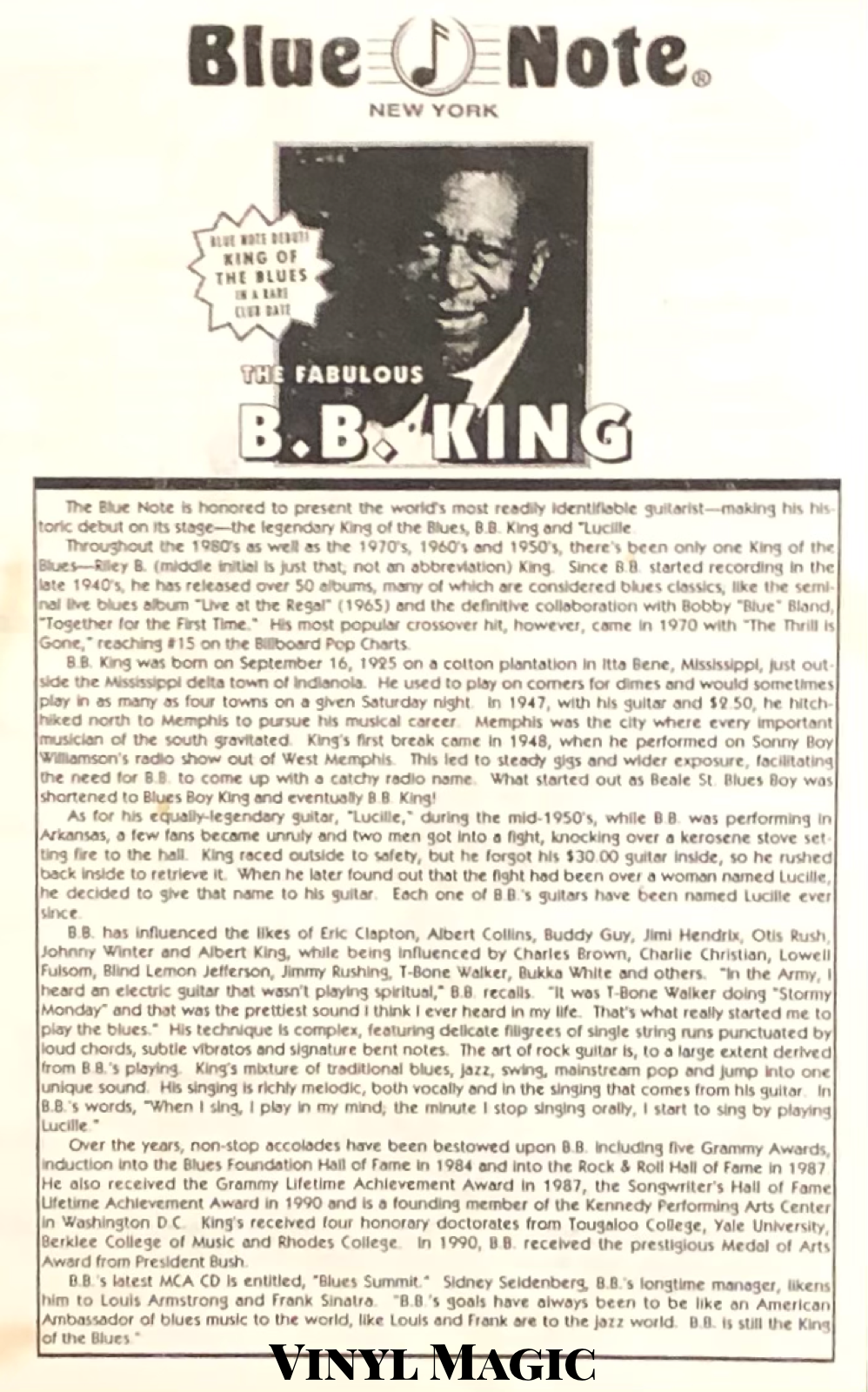
In 1993, The Blue Note in New York City advertised "A Rare Club Date With B.B. King." I bought tickets, and Erin and I and some friends showed up early for the first come, first served general admission. We ended up front row center, directly in front of his eminence. B.B. had his entire twelve piece band with him and it was quite a sight in this small, intimate and fabled New York City jazz club. In those days, the Blue Note had mostly jazz quartets and quintets, and they were not equipped to service B.B.'s large band requirements and retinue. In fact, B.B.'s three piece horn section was relegated to off stage because they could not fit. They played off stage mostly, but when they did a solo, they scurried on, blew a few beautiful notes, and then returned to the shadows. The life of a side man. Not twenty feet from greatness, more like eight...

B.B. and his band played an incredible set of music. He opened with "Let The Good Times Roll" and we were transported to another world. "Lucille" never sounded better as B.B. coaxed and bent beautiful, crystalline blues. As he went through "Sweet Sixteen", "When It All Comes Down", "Rock Me Baby" and "The Thrill Is Gone", the blues were never so joyous and life affirming. The crowd erupted into a standing ovation as he finished his set. A bunch of folks started reaching out to B.B. for a handshake or a memento. B.B. saw Erin directly in front of him, smiled and handed his guitar pick to her. B.B. always had an eye for the ladies, and he has reputedly sired 15 children with 15 different woman. Apparently, as hard as he worked on stage, he was as equally tireless off.

B.B. King pick/Blue Note program 1993

When I met with him backstage, B.B. was kind and generous. He loved seeing some of the old albums, “Look how skinny I am, and young!" He was especially interested in Singin' The Blues, his debut album released in 1956, and he paused as he looked at the song titles with care. He couldn't have been nicer as he stuck out a big mitt to shake hands.

B.B. King overcome with excitement... backstage at the Blue Note, New York City 1993

B.B. King overcome with excitement... backstage at the Blue Note, New York City 1993

BB King and Me, Blue Note dressing room, B understandably overwrought with emotion

Several years later, he published an autobiography, Blues All Around Me (1996), which was an honest and open look at his career and influences. Perhaps a little too open and honest. I found it interesting that he loved Frank Sinatra:: "I'm a Frank Sinatra nut. No one sings a ballad with more tenderness...and when Sinatra wants to swing, no one swings harder. No one phrases any hipper." And for guitar inspiration, he listened to Les Paul, inventor of the solid body electric guitar and many other recording advances like overdubbing. Less interesting was a chapter entitled "Someone Asked Me About Oral Sex." Really B? I can think of a lot of other interesting questions. This might be the most improbable chapter in the history of music autobiography! Prurient, salacious, and completely unnecessary, it is hard to believe that a publisher or editor fought for this chapter's inclusion. I couldn't believe what I was reading so I read it over and over and over and over again, just to make sure I wasn't missing anything.

B.B. King, blues icon, legend, ladies man. Never have the blues felt so satisfying. The thrill is never gone.

Blues n Jazz (1983) signed by B.B..

Blues n Jazz (1983) signed by B.B..

Blues n Jazz (1983) signed by BB

Live At The Apollo (1999) signed by B.B.

Live At The Apollo (1999) signed by B.B.

Live At The Apollo (1991) signed by BB

Choice B.B. King Cuts (per BKs request)

https://www.youtube.com/watch?v=SgXSomPE_FY

“The Thrill Is Gone” live with Eric Clapton Crossroads Festival 2010

https://www.youtube.com/watch?v=LWLAAzOBoBI

“I’ve Been Downhearted, Baby” live Sing Sing Prison 1972

https://www.youtube.com/watch?v=WFi3C_5U9_Y

“Stormy Monday” live at Austin City Limits 1996

https://www.youtube.com/watch?v=DQfDT-PCjyI

“Night Life” Austin City Limits 1983

https://www.youtube.com/watch?v=sQQ_vl47CGc

“I Believe To My Soul” Live in Zaire 1974

https://www.youtube.com/watch?v=72kyjRpVi1I

“Five Long Years” live 1998

https://www.youtube.com/watch?v=GpoH2IY2Mcc

“I’ve Got A Mind To Give Up Living” live 1968

https://www.youtube.com/watch?v=WrpFrizfMTM

“Three O’Clock Blues” with Eric Clapton

https://www.youtube.com/watch?v=vnlwxS-36AU

“Why I Sing The Blues” live with Albert King, Etta James, Stevie Ray Vaughan

https://www.youtube.com/watch?v=dNr_eIgP0tI

“Sweet Little Angel” live

https://www.youtube.com/watch?v=7p80MSFUOfk

“Slow Blues #1” live with Jimi Hendrix 1969

https://www.youtube.com/watch?v=NuND2iC4oJc&list=PLSQ9_a7EjS7edlylPLqMdfIxdkdUHFLnp

“Precious Lord” B.B. King Sings Spirituals 1959

Andy Warhol, Johnny Griffin and Me...

Jazz is music made by and for people who have chosen to feel good in spite of conditions.

               Johnny Griffin

IMG_7922.png

The Congregation (1957) signed by Griffin, art by Warhol

Before Andy Warhol was the acclaimed and influential icon Andy Warhol, he was a young artist who drew and designed album covers. One of his earliest commercial works was Carlos Chavez's A Program Of Mexican Music completed in 1949 when Andy was only 21. When Andy became famous, he designed album covers for The Velvet Underground in 1967 (probably the only album cover that highlights the artist and not the band), the Rolling Stones' Sticky Fingers in 1971 (with working zipper!) and Love You Live in 1977, Diana Ross' Silk Electric in 1982, and Aretha Franklin's Aretha in 1986. Earlier album covers were illustrated for artists as diverse as Vladimir Horowitz, The Boston Pops, Count Basie, Kenny Burrell, Thelonious Monk and Johnny Griffin.

IMG_7991.png

The Velvet Underground (1967) signed by Lou Reed

Johnny Griffin, a tenor saxophonist from Chicago, diminutive in stature, was nicknamed "The Little Giant." Despite his lack of physical presence, Johnny was a hard blowing tenor giant, and the winner of many cutting sessions with his fellow peers and collaborators. A Blowin’ Session (released in 1957) is considered the greatest hard bop jam session ever, and features Griffin, John Coltrane and Hank Mobley furiously trading tenor solos, while pianist Wynton Kelly, bassist Paul Chambers, and drummer Art Blakey supply impeccable rhythm. As Johnny once remarked, "I like to play fast. I get excited, and I have to sort of control myself, restrain myself. But when the rhythm section gets cooking, I want to explode." Johnny released other important jazz albums, and like many of his jazz brethren, he relocated to Europe from the mid-1960s through 2008 when he died.

IMG_7881.png

The Little Giant (1959) signed by Griffin, Julian Priester

IMG_7878.png

Little Giant (compilation 1959 recordings) signed by Griffin

I saw Johnny several times through the years when he visited from his safe European home. He was a riveting performer and I was always struck by his big, fat, warm, wonderful sound. At the times, the tenor saxophone looked bigger than he, as it had swallowed him whole, but Johnny had such skill and ferocity when he was playing. One of my favorite songs was a blues vamp that he wrote, "The JAMFs Are Coming." He explained that it was an acronym for "the jive ass motherfuckers" are coming. No lyrics, just a blues groove propelled by his searing hard bop tenor. When Johnny signed The Congregation, with the cover drawn by Andy Warhol, I asked Johnny if he had the original Warhol drawing. "No. I don't have it. I wish I did and I'm not sure where it ended up," came his modest reply. Well, I told him, I know where the Hawaiian shirt is, it's hanging in my closet.

The JAMFs are coming indeed.

IMG_6436.png

Griff & Lock (1960) signed by Griffin, Junior Mance

IMG_7995.png

Serenade To A Bus Seat (1957) signed by Griffin, Clark Terry

IMG_7849.png

With Flute To Boot (1958) signed by Griffin, Herbie Mann, Curtis Fuller

IMG_7826.png

Big 6 (1958) signed by Griffin, Curtis Fuller

IMG_7879.png

Thelonious In Action (1958) signed by Griffin, Roy Haynes

IMG_4849.png

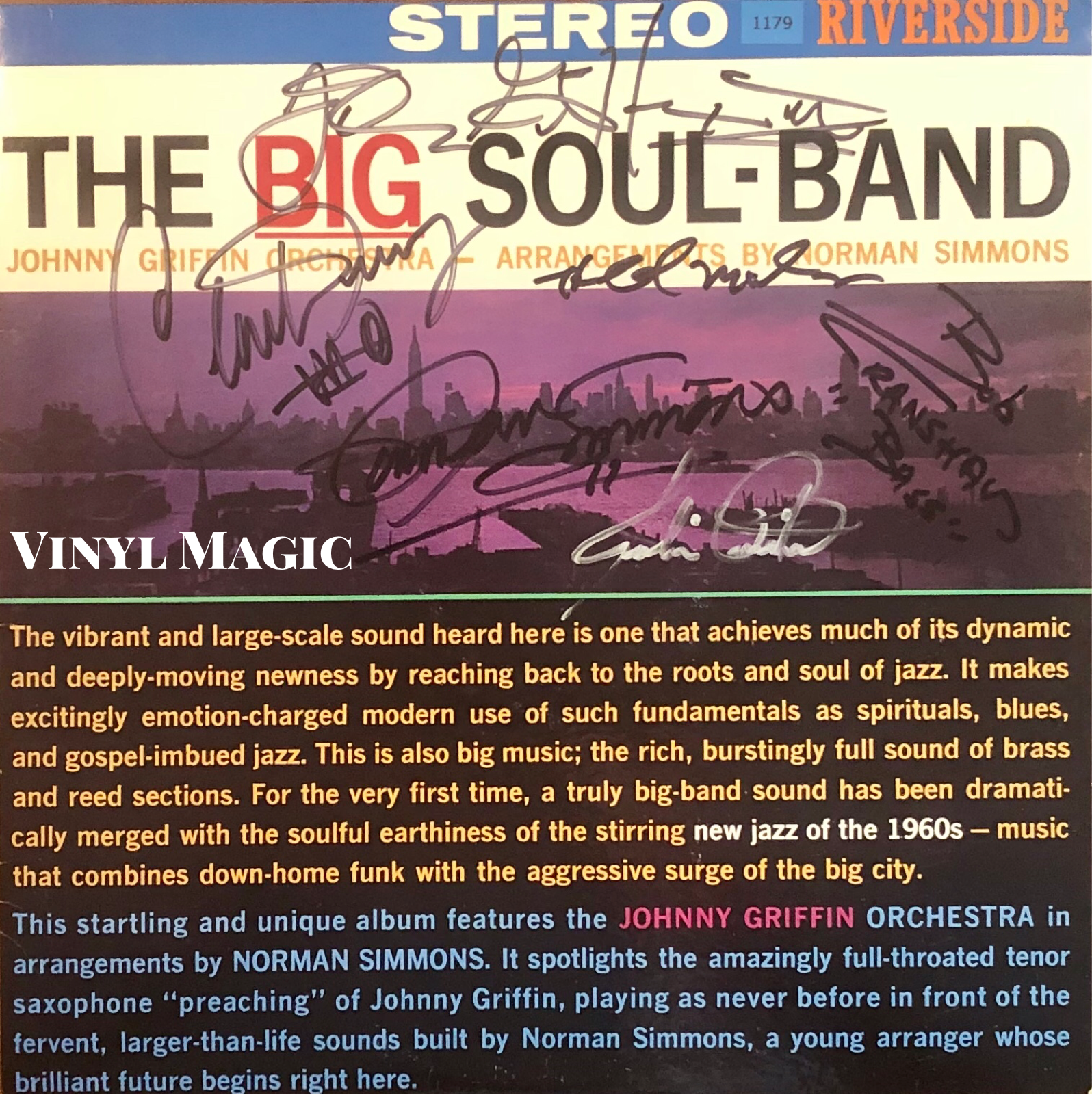
The Big Soul Band (1960) signed by Griffin, Clark Terry, Bob Cranshaw, Norman Simmons, Harold Mabern, Julian Priester

IMG_0735.png

Battle Stations (1960) signed by Griffin

IMG_7919.png

Grab This! (1963) signed by Griffin

IMG_0324.PNG

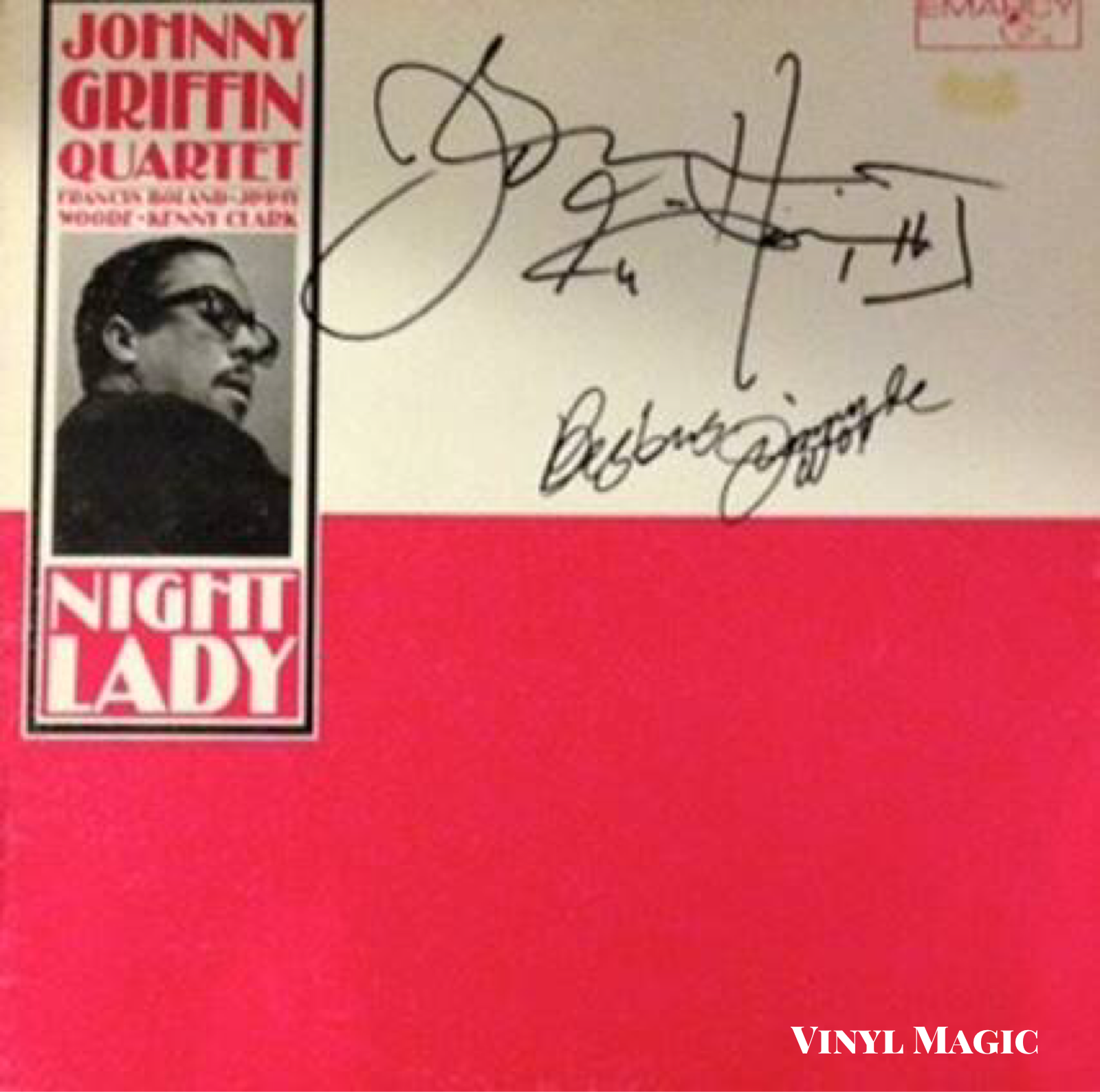
Night Lady (1963) signed by Griffin, Jimmy Woode

IMG_0299.PNG

Return Of The Griffin (1979) signed by Griffin

IMG_0318.PNG

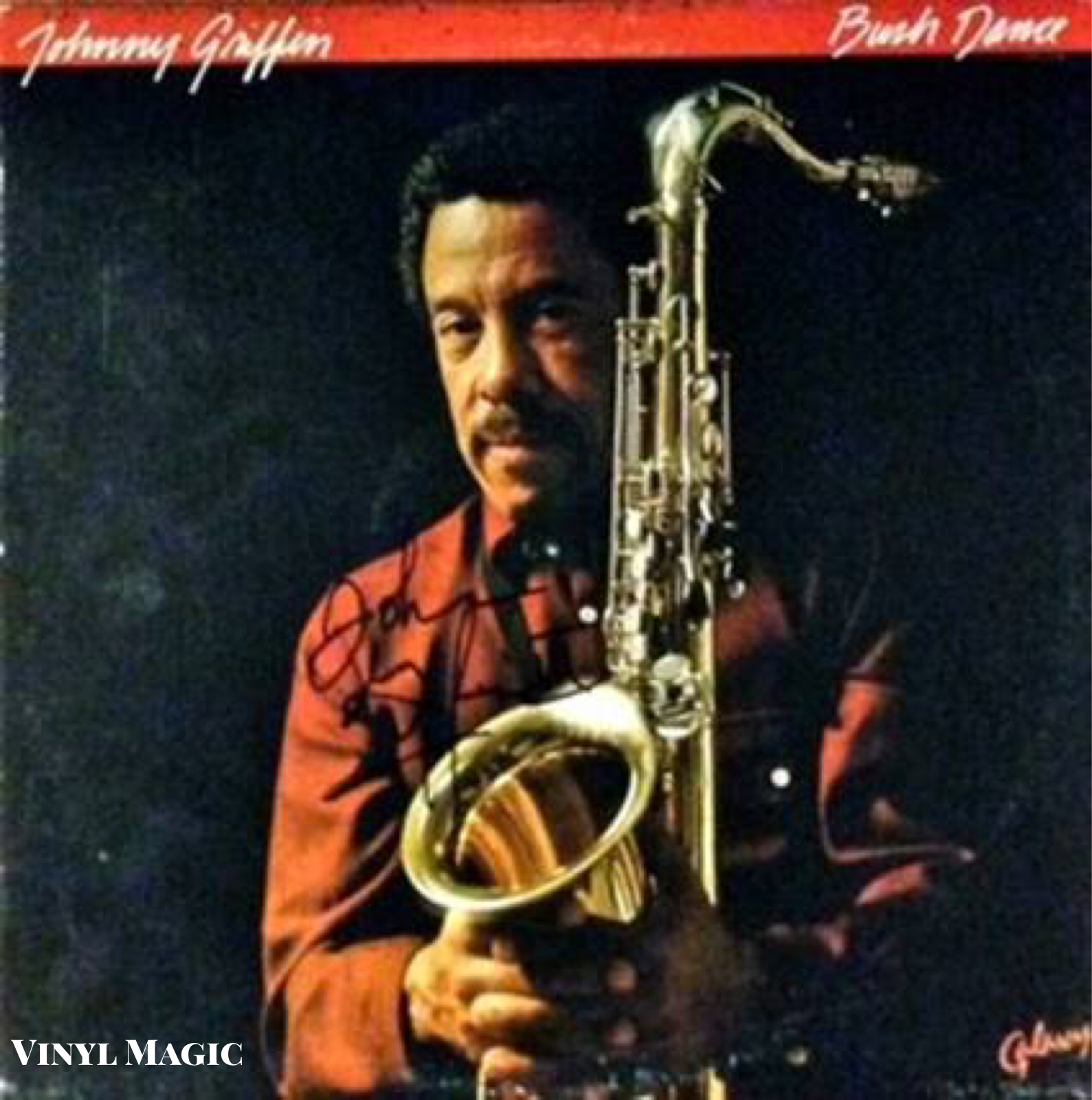
Bush Dance (1979) signed by Griffin

Choice Johnny Griffin Cuts (per BKs request)

https://www.youtube.com/watch?v=ZhfEq1WFl2g

"The JAMFs Are Coming"  Live in France 1971

 https://www.youtube.com/watch?v=Q-SYoldqi64

"A Night In Tunisia" Johnny and Dizzy Gillespie in France 1971

 https://www.youtube.com/watch?v=L3kEnoXaYYo

"Blue Monk"  Johnny blows with Thelonious Monk and Art Blakey  1958

 https://www.youtube.com/watch?v=dpzxMLawHic

"Don't Get Around Much Anymore" Johnny swings Duke  1963

https://www.youtube.com/watch?v=zmycL-CZtfo

"Grab This!"  Grab This!  1963

 https://www.youtube.com/watch?v=cDbopNNlWKk&list=PLA510E534276EA049

"The Way You Look Tonight"  A Blowin' Session  1957

All signed albums from the Kirk vinyl collection  

copyright 2019

Tito Puente, Mona and Me...

Everybody's heard of Santana. Santana! Beautiful Santana! He put our music, Latin rock, around the world, man! And I'd like to thank him publicly 'cause he recorded a tune and he gave me credit as the composer of the tune. So, since that day... all we play... is Santana music!

               Tito Puente on Santana covering his song "Oye Como Va”

Cuban Carnival (1956) signed by Tito

Cuban Carnival (1956) signed by Tito

Dance Mania (1958) signed by Tito

Dance Mania (1958) signed by Tito

Dance Mania (1958 import) signed by Tito

Dance Mania (1958 import) signed by Tito

The only salsa I know is sold in a bottle called ketchup. I play Cuban music.

              Tito Puente

Ernesto Antonio "Tito" Puente spent much of his childhood in Spanish Harlem in New York City where he became immersed in the Latin rhythms of the day. After being drafted in 1942, Tito served in the US Navy for three years, and he saw nine battles on the escort carrier USS Santee. After being discharged with a Presidential Unit Citation, Tito formally studied music theory, orchestration and conducting (via the GI Bill) at the Julliard School of Music in New York.

In 1947, Tito joined Machito's orchestra as a drummer, then switched to the timbales. Machito's orchestra was the first to incorporate Afro-Cuban rhythms and introduced the triple play of conga, bongos and timbales as the standard Latin percussion. In the early 1950s, Tito started his own orchestra and he helped foment the mambo and Latin dance craze. Shows at the Palladium were legendary and introduced the "cha cha cha", mambo and other dances to an enthusiastic and wider audience than the uptown Latin clubs. Tito became "El Rey del Timbal" or just "El Rey."

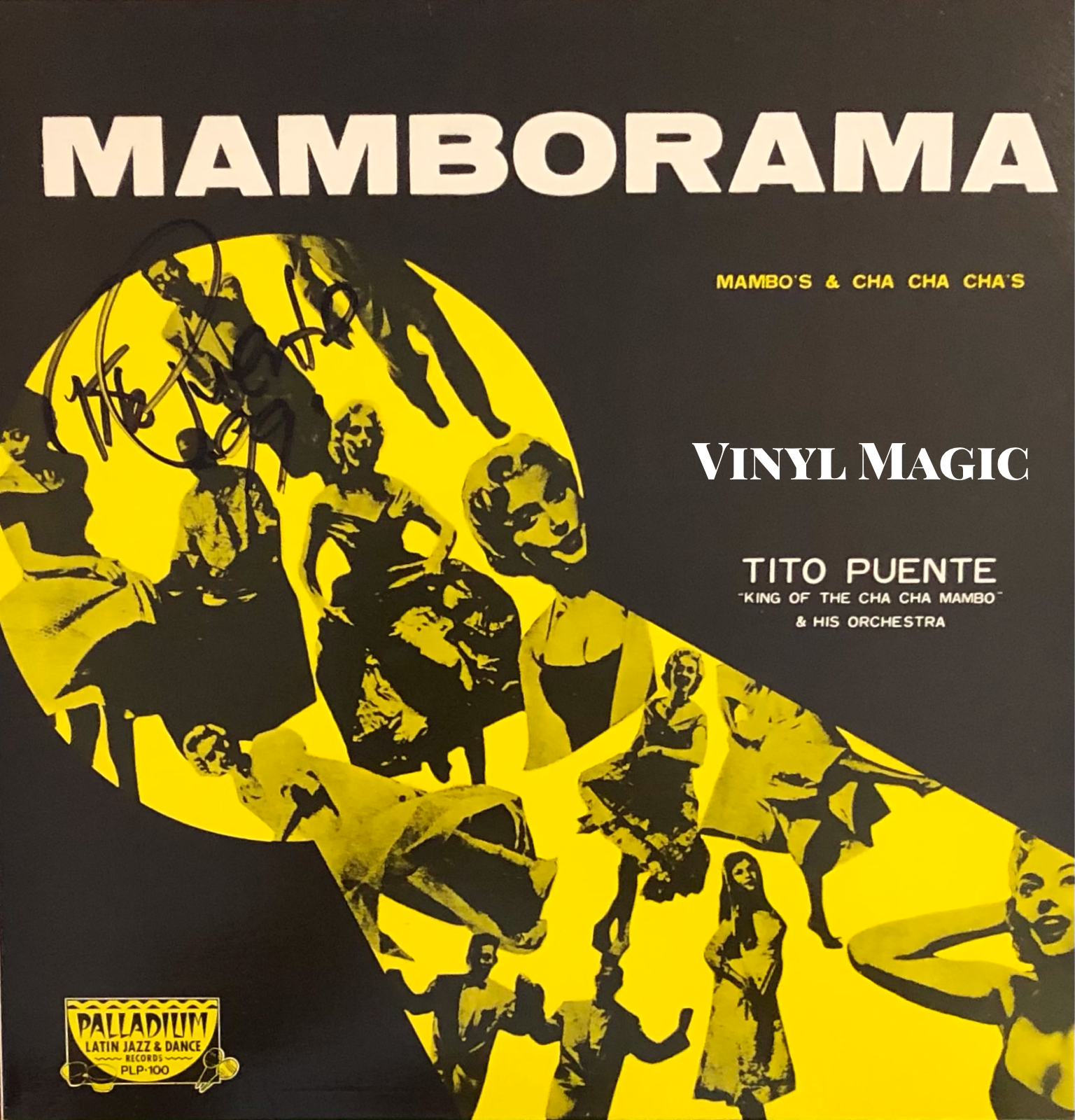
Mamborama (1955) signed by Tito

Mamborama (1955) signed by Tito

Tito Puente released over one-hundred albums in his brilliant career and is probably the most well known and beloved star in Latin or Latin jazz history. He won five Grammy awards and appeared on The Cosby Show (when it was a mark of distinction!) and The Simpsons (still a hallmark of excellence and cultural relevance!). He also helped the careers of many important Latin musicians: Ray Barretto, Willie Bobo, and Mongo Santamaria played in Tito's band and had considerable success as solo artists.

Top Percussion (1957) signed by Tito

Top Percussion (1957) signed by Tito

Tito's music was exposed to the Woodstock generation when Santana recorded "Oye Como Va" (written in 1963) on Santana's breakthrough Abraxas (1970) album. "Oye Como Va" has become Tito's most well known composition. At shows thereafter, Tito gratefully acknowledged the great guitar master's exposure as a wonderful boost to his career. And the songwriting royalties didn't hurt either!

I saw Tito and his orchestra dozens of times over the years and his music was so powerful, joyous and uplifting. Most jazz and rock bands have the percussion set up in the back. Not Tito. Timbales, conga, bongo all in front. The spotlight and focus was on Tito and he reveled in it. He was a showman's showman. His percussion was the propulsive locomotive of the entire band. As Count Basie said of his big band, "we have a good night if our drummer (Jo Jones) has a good night,” and every night with Tito was a great night. The horn section anchored by Mario Rivera on tenor saxophone and Ray Vega on trumpet was placed in back of the percussion, and what a joyful noise those ten or twelve collective pieces made!

One day when I was digging through crates at a record store, I came across Music For Romancing (1955), a mambo compilation with a very alluring model reclining on her back, two wine glasses nearby, a lit cigarette burning in an ashtray full of stubs. The cigarette wasn't the only thing smoldering, she was sultry and sexy. The record was on Tico, a label started by George Goldner in 1948 which became home to early recordings in the 1950s by Tito Puente, Tito Rodriguez and Machito - The Mambo Kings. I scanned the back cover, there was no mention of any artists. I looked again at the front cover. Easy call. I buy. I slipped the record into my stack and I went to the checkout to purchase it.

Music For Romancing (1955) signed by Tito

Music For Romancing (1955) signed by Tito

Many years later, I saw Tito for the last time at The Blue Note in NYC in early 2000. He was in great form and he had his superlative musicians with him. I knocked on the dressing room door, and Tito invited me in. He was with a friend. I showed Tito the album  Music For Romancing. I asked him, ‘Who’s the babe on the cover?’ Tito was excited. He grabbed the album from me and showed it to his friend who was sitting on a couch five feet away. Tito unleashed a torrent of Spanish incomprehensible to me, save one word: "tits." My ears perked. Then he turned to me. Solemnly, he said, "You know who that babe is? I can tell you exactly who that babe is. Her name was Mona. She had gorgeous tits. Look at her tits. She was the wife of the president of my record label (Tico). Look how beautiful her tits are." I took the bait. There was something wonderfully alliterative (and naughty) in talking tits with Tito. I said, ‘Tito, I love tits. My wife has great tits. Would you mind signing Mona's tits?’ "Yes, I'd be delighted to sign her tits" came the quick reply. "Best wishes, Tito Puente '00" was lovingly scrawled on possibly my favorite record cover.


In real life, Mona was Ramona Goldner, the Puerto Rican born wife of Tico record label president and founder George Goldner. Mona was so beautiful that Tito Rodriguez, fellow Mambo King, wrote "Mambo Mona" or "Mama Guela" as a tribute to her ravishing looks, a song which has become a Latin jazz standard. And George Goldner's interest in Latin music started with his wife's introduction to those wonderful, sensuous rhythms and sounds. While Mona may not have been the face that launched a thousand ships, she certainly moved and inspired thousands of hips!

Let’s Cha Cha Cha With Puente (1959) signed by Tito

Let’s Cha Cha Cha With Puente (1959) signed by Tito

Thanks El Rey for your joyous and life affirming music, and your discerning eye for talent on and off stage.

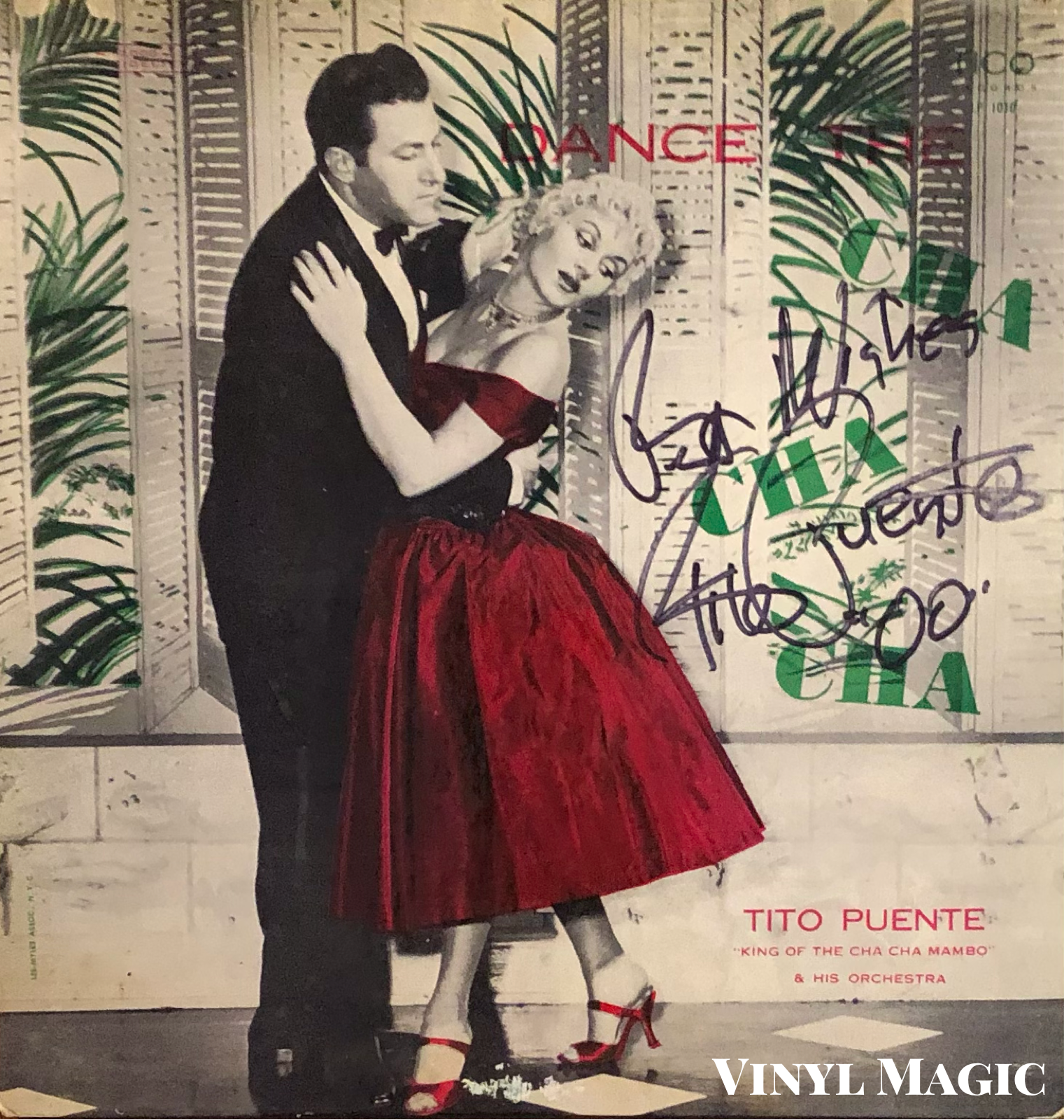
Dance The Cha Cha Cha (1959) signed by Tito

Dance The Cha Cha Cha (1959) signed by Tito

Mucho Cha Cha (1959) signed by Tito

Mucho Cha Cha (1959) signed by Tito

Dancing Under Latin Skies (1959) signed by Tito

Dancing Under Latin Skies (1959) signed by Tito

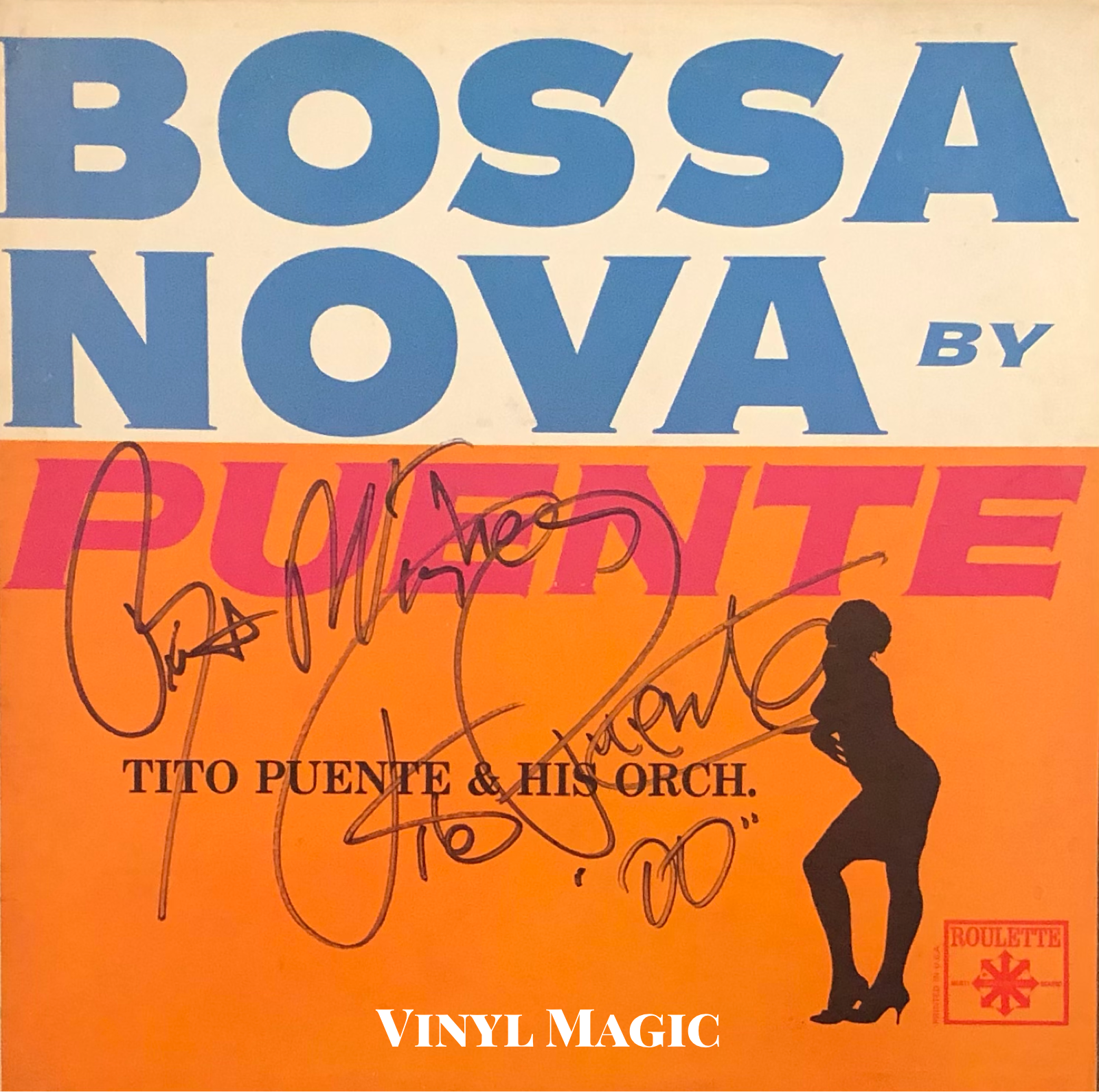
Bossa Nova By Puente (1962) signed by Tito

Bossa Nova By Puente (1962) signed by Tito

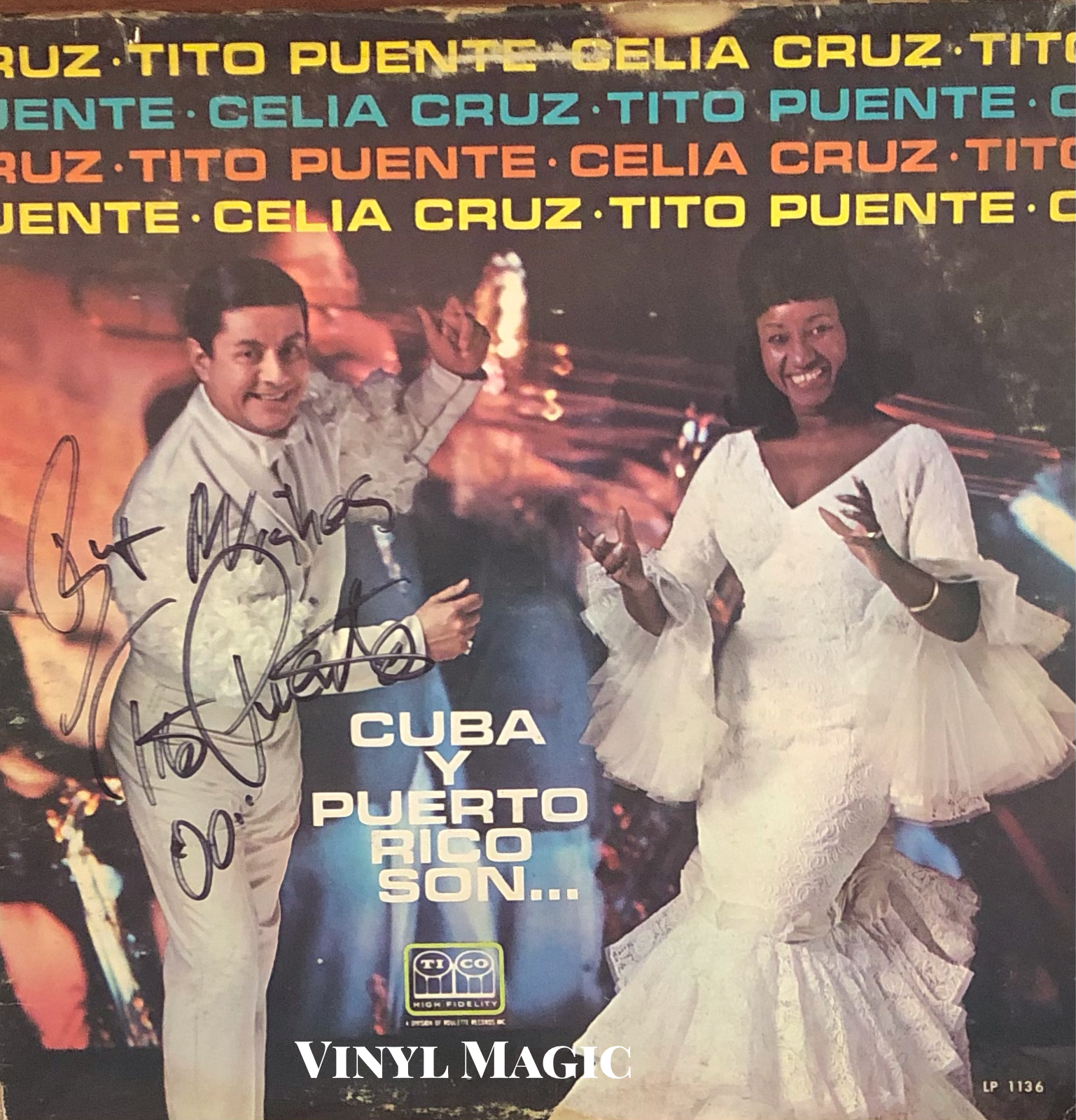
Cuba y Puerto Rico Son (196) signed by Tito

Cuba y Puerto Rico Son (196) signed by Tito

El Rey y Yo (1967) signed by Tito

El Rey y Yo (1967) signed by Tito

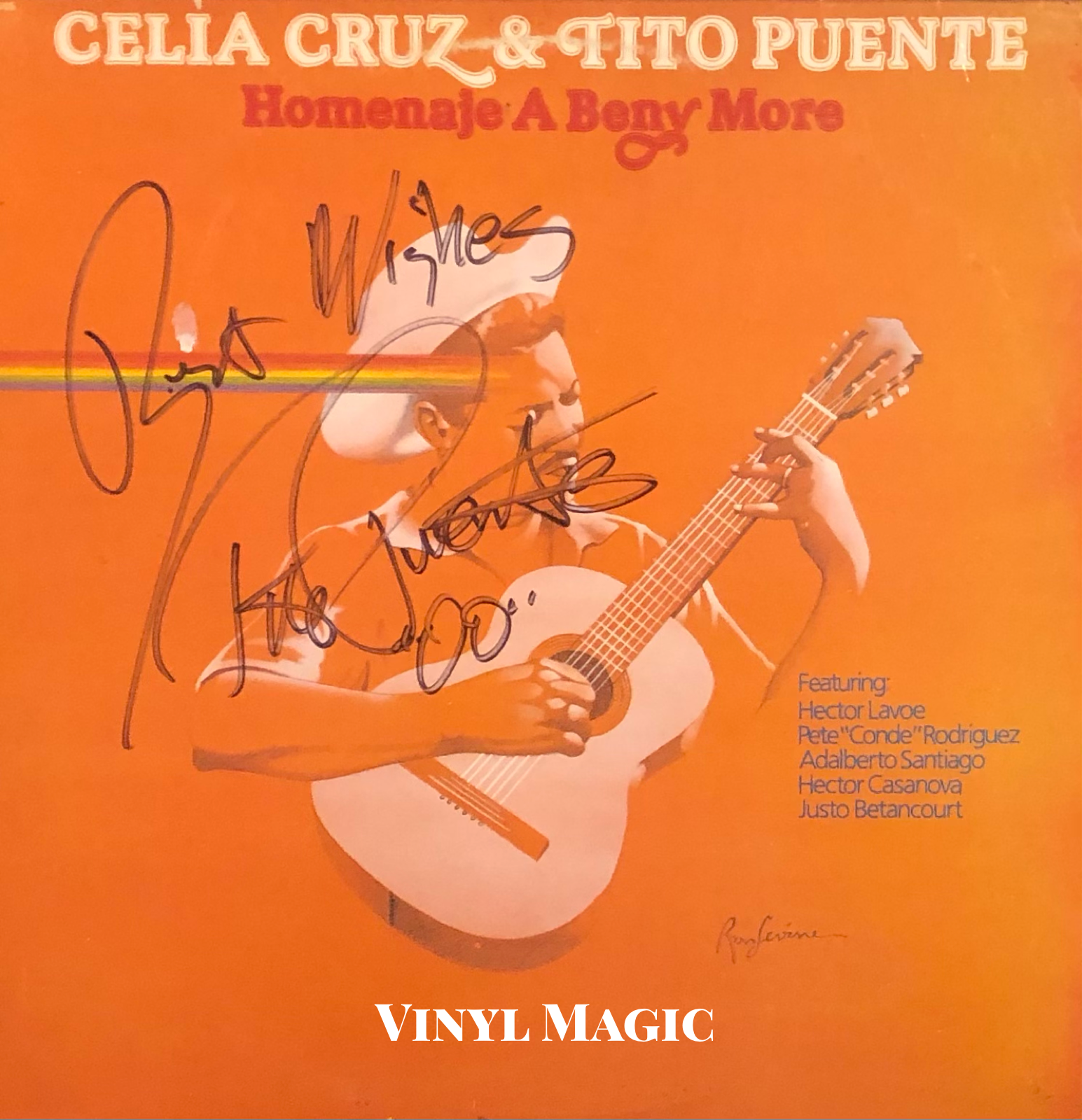
Homenage A Beny More (1978) signed by Tito

Homenage A Beny More (1978) signed by Tito

CE’ Magnifique (1981) signed by Tito

CE’ Magnifique (1981) signed by Tito

Choice Tito Puente Cuts (per BKs request)

https://www.youtube.com/watch?v=1HfXCZGOcDM

“Oye Como Va” Village Gate with Dizzy Gillespie 1986

https://www.youtube.com/watch?v=TXBgJ2ajjQs

“Ti Mon Bo” Top Percussion 1957

https://www.youtube.com/watch?v=WnuLofOrNyU

“Don’t You Worry’Bout A Thing” Tito plays Stevie!

https://www.youtube.com/watch?v=KNifUszz2zA

“Hong Kong Mambo” Dance Mania 1958

https://www.youtube.com/watch?v=TvMNjdz9Gcw

“Ran Kan Kan” live

https://www.youtube.com/watch?v=Zm2C5hx4sI0

“Quimbara” Tito plays, Celia Cruz sings!

https://www.youtube.com/watch?v=eewrHI2dFfs

“Descarga with Cachao” Atlanta Jazz Festival 1990

https://www.youtube.com/watch?v=RPvMEZoZoZU

“Five Beat Mambo” live

https://www.youtube.com/watch?v=v6fhsmVyNaw

“El Cumbanchero” live 1965

https://www.youtube.com/watch?v=ZxzphmtiUVk

“Jam” live at Montreux 1980

Bonus picks:

https://www.youtube.com/watch?v=J7ATTjg7tpE

“Oye Como Va” Santana Abraxas 1970

https://www.youtube.com/watch?v=m8nkXC9TxKs

“Mambo Mona” Tito Rodriguez

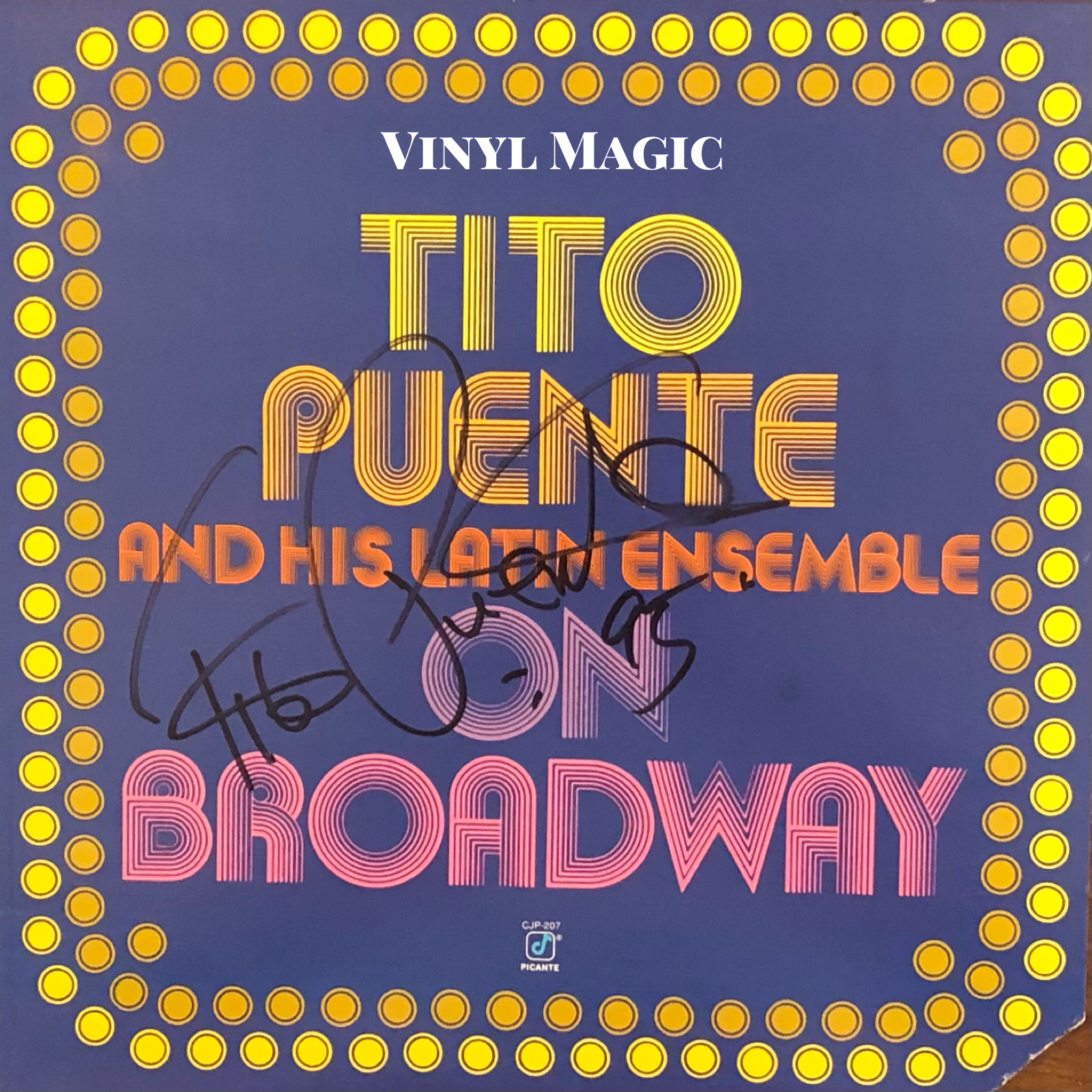
On Broadway (1983) signed by Tito

On Broadway (1983) signed by Tito

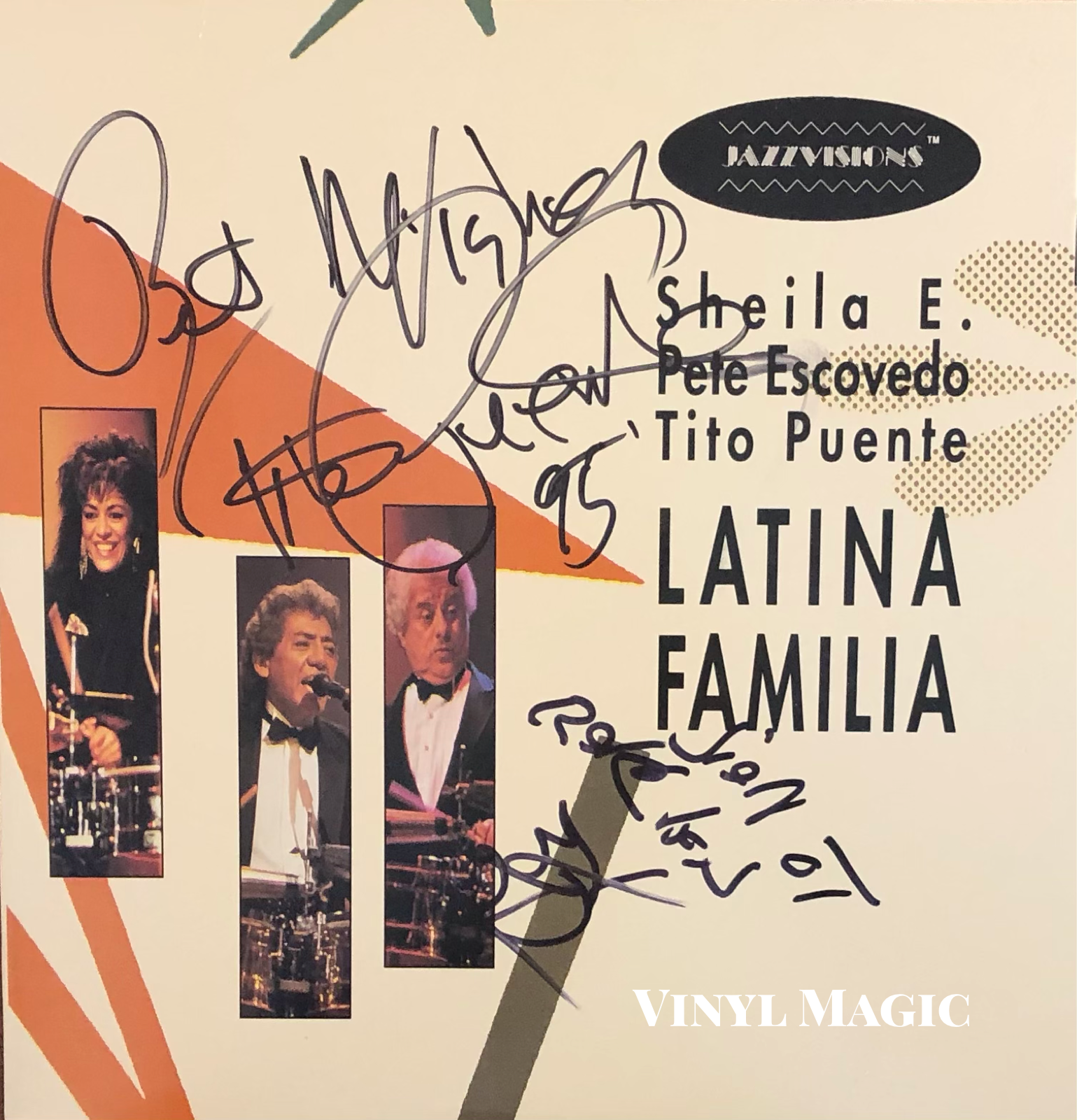
Latina Familia (1989) signed by Tito, Sheila E.

Latina Familia (1989) signed by Tito, Sheila E.

Un Poco Loco (1987) signed by Tito

Un Poco Loco (1987) signed by Tito

John Fahey and Me...

For nearly ten years, I have been posting vignettes to my friends and colleagues on my insane record collection and the attendant autographs/interactions with the artists (some 200+ so far in total). It has been a labor of love, and, hopefully, as informative and entertaining for my readers as it has been for me. Everyone from Sinatra to the Sex Pistols, Sonny Rollins to Johnny Cash, The Grateful Dead to Lou Reed, no one has been spared in my dogged pursuit.

The genesis started innocently. In my never ending and insatiable search for music in all genres, I read a lot of blogs. A couple of years ago, I came across a not particularly well written John Fahey post. I thought three things: I can write better, I have better stories, and my kids see all this junk in our music room and they have no idea who many of these artists are, and the album artwork is as compelling as some of the back stories are interesting.

So, blame it all on John Fahey. In his incandescent memory, here's the first post which I ever sent, along with some Holiday tunes (and vinyl artwork!)....

IMG_0248.JPG

When I play, I very quickly put myself into a light hypnotic trance and compose while playing, drawing directly from the emotions.


John Fahey (1939-2001)

John Fahey, an American guitarist, composer and savant, is so wide ranging in his material, from blues to folk to avant garde, that his music is beyond category. John also released a series of instrumental Christmas albums which have been holiday staples in my house since the late 1970s. "Silent Night,” "Joy To The World,” and "O Holy Night" have never sounded better. I was lucky to see Fahey several times over the years, and I was always struck by a man who looked so menacing, yet created such tender and exquisite melodies.

The New Possibility (1968) unsigned

The New Possibility (1968) unsigned

One night, back in December 1983, Erin and I went to see him perform at the Birchmere, a small club in Alexandria, Virginia. The Birchmere then was in a converted used furniture store and it retained a similar, decaying ambience: picnic tables with naugahyde chairs stuck to a filthy linoleum floor, the aroma of stale beer, cheap wine and unfiltered cigarettes hung heavy in the still, acrid air. John was playing his usual eclectic set when he stopped and asked the audience for a drink, "Not beer or wine," like the Birchmere served, "but a real drink. Someone must have something in their car," he implored. One audience member volunteered that he had something in his car. John said he would wait. We did. When the audience member returned, he went onstage and handed John a bottle of brandy, which he chugged to the delight of the audience. John resumed playing flawlessly.

After the show, I went backstage to get an album signed. The dressing room door was slightly ajar so I went in. There was a bathroom in the dressing room and that door was wide open. John had his back to me, and he was unleashing a furious torrent. He turned and said he’d be done in a minute. I said I didn’t mean to bother him, I could see he had his hands full. He laughed, finished his business, wheeled around and stuck out a big unwashed paw. I told him how great the show was and asked him to sign an album. He happily obliged, then asked, "Where do you live? Do you have anything to drink in your house?" I thought about this. It would be awesome to bring John Fahey back to my house and play records, stay up and drink all night. But what if it went wrong? John was a big man, and I knew I could be belligerent when I got over served, what if Fahey and I broke bad?  'No, I don’t really have anything,' I sheepishly told him. I thanked him and left.

When I returned to my table, I told Erin that Fahey wanted to come home with us. I explained my misgivings. She said I should have said yes. That wasn’t the last time I was wrong about something….

IMG_0249.JPG

Popular Songs Of Christmas & New Year’s (1983)

IMG_6035.png

Back cover signed by John Fahey

IMG_5792.png

God Rest aye Merry Jazz Men signed by Jimmy and Percy Heath, Wynton Marsalis, Paquito D’Rivera, Arthur Blythe, McCoy Tyner

IMG_4508.png
Christmas With McGriff (1964) signed by Jimmy McGriff

Christmas With McGriff (1964) signed by Jimmy McGriff

Christmas With McGriff 1970s reissue with Jimmy’s niece on cover.

Christmas With McGriff 1970s reissue with Jimmy’s niece on cover.

That Holiday Feeling (1990) signed by Joe Williams
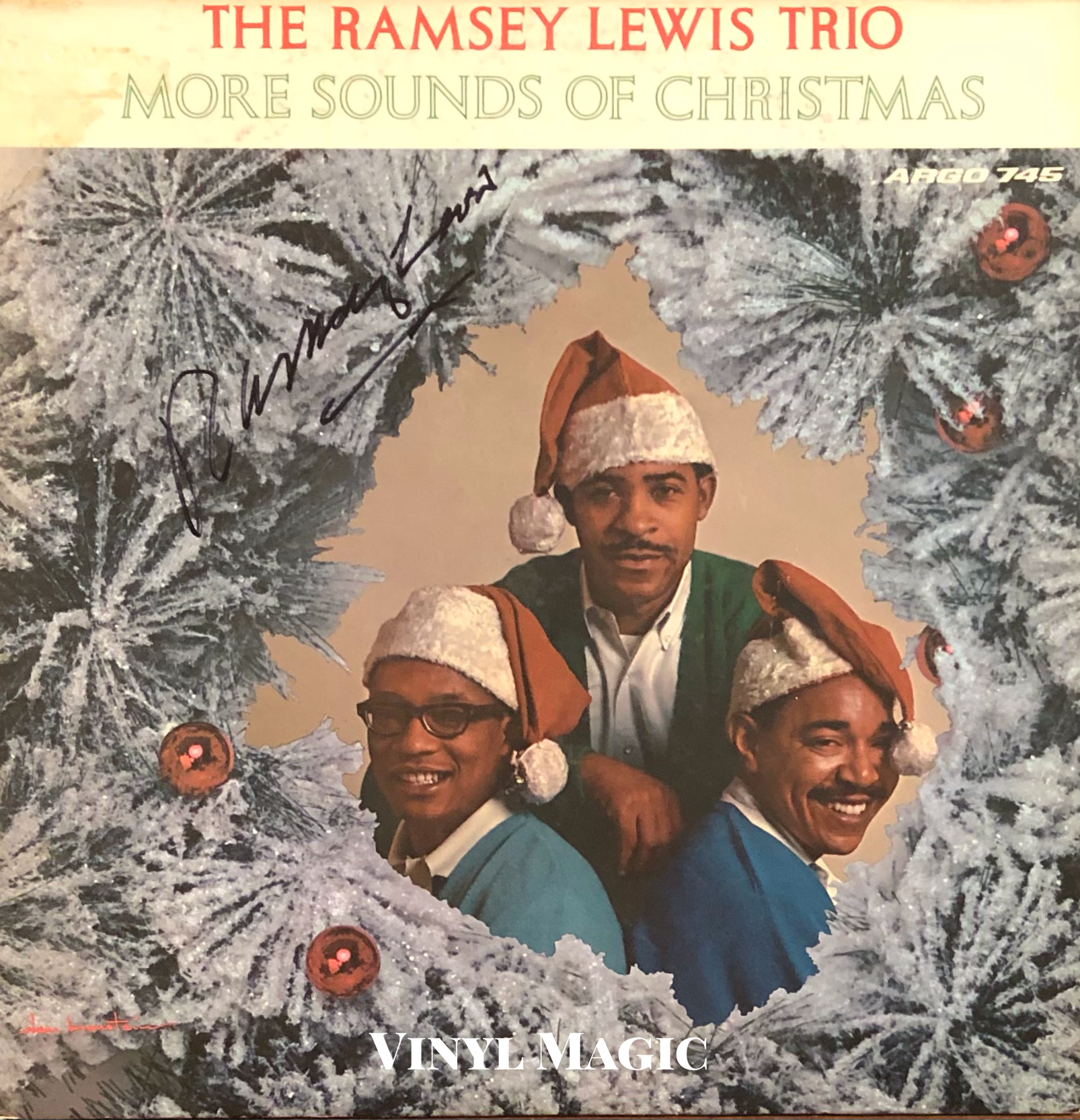
That Holiday Feeling (1990) signed by Joe Williams

The Charlie Byrd Christmas Album (1981) signed by Charlie

The Charlie Byrd Christmas Album (1981) signed by Charlie

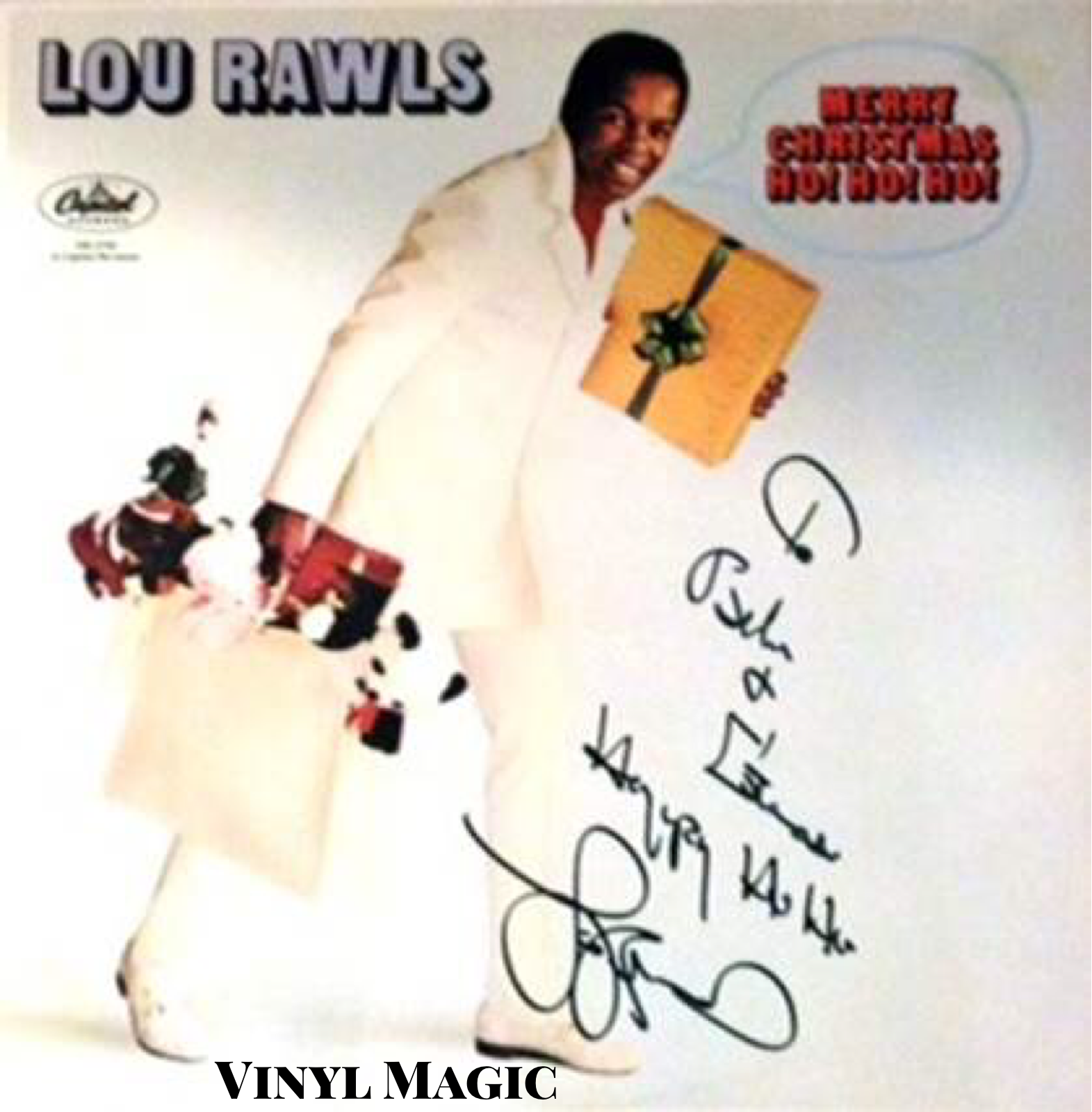
Merry Christmas! Ho! Ho! Ho! (1967) signed to my parents from Lou Rawls

Merry Christmas! Ho! Ho! Ho! (1967) signed to my parents from Lou Rawls

IMG_0258.JPG

Natty Christmas (1987) sadly unsigned by Jacob Killer Miller

All signed albums from the Kirk vinyl collection 

Copyright 2019

Robert Hunter, T.S. Eliot, The Grateful Dead and Me...

Walking down Madrone Canyon in Larkspur in 1969, you said some pretty mind-blowing stuff, how we were creating a universe and I was responsible for the verbal half of it. I said maybe, but it was your way with music and a guitar that was pulling it off. You said "That's for now. This is your time in the shadow, but it won't always be that way. I'm not going to live a long time, it's not in the cards. Then it'll be your turn." I may be alive and kicking, but no pencil pusher is going to inherit the stratosphere that so gladly opened to you. Recalling your statement, though, often helped keep me oriented as my own star murked below the horizon while you streaked across the sky of our generation like a goddamned comet!

               Robert Hunter, letter written upon the one year anniversary of Jerry Garcia's death, 1996

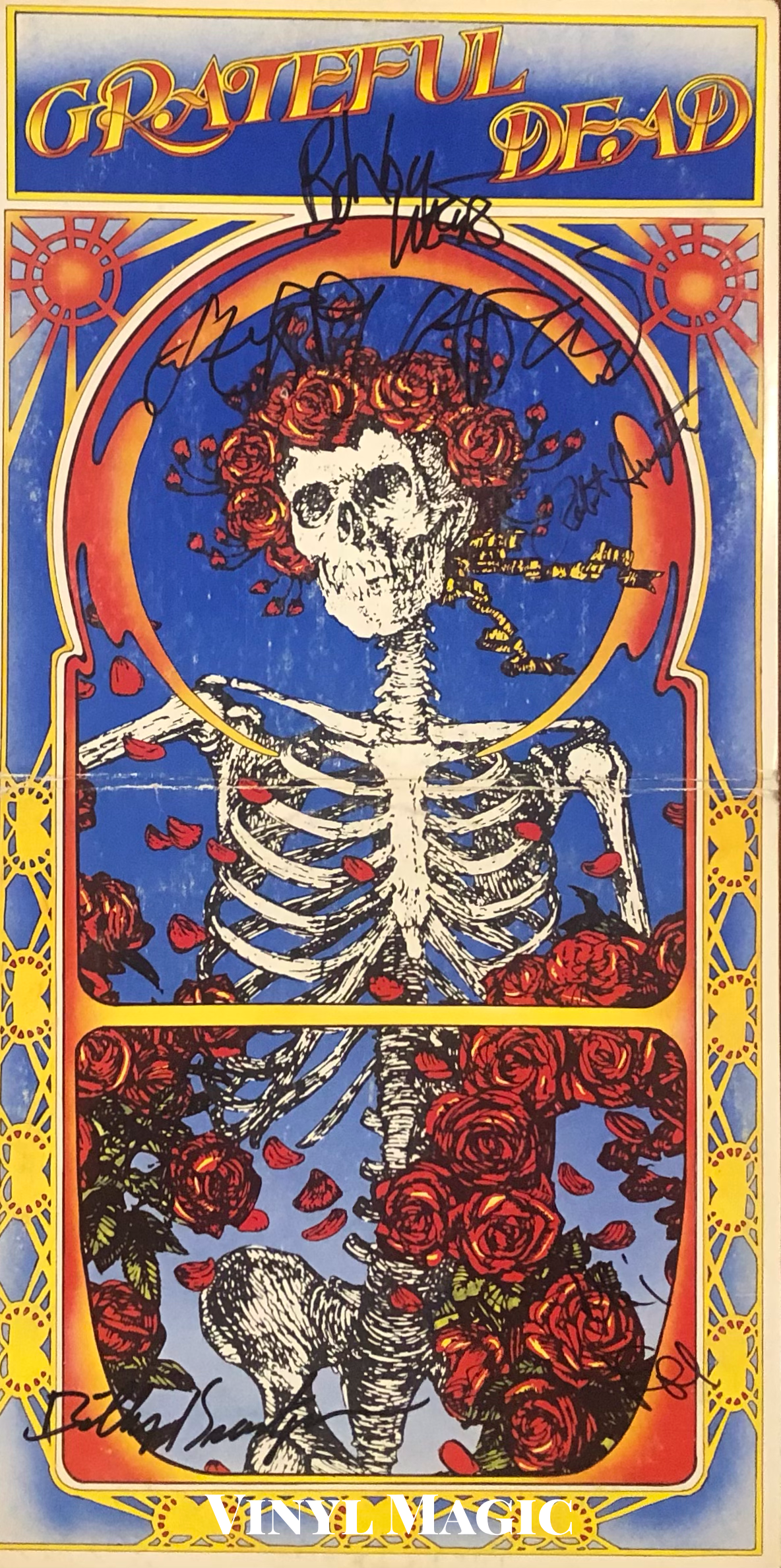
Skull & Roses (1971) signed by Jerry Garcia, Phil Lesh, Bob Weir, Robert Hunter, Bill Kreutzman

I met Robert Hunter, lyricist nonpareil for the Grateful Dead, during a soundcheck before his show at the City Winery in New York City in July 2014. I had last seen Robert perform many years ago in Boston during college. While his literary and lyrical talents abound, his music and singing is more of an acquired taste. One that I have not yet acquired. What I remember from seeing him then, was Hunter shouting “Promontory Rider” at the top of his coarse lungs. Over and over. Seeing him once was more than enough for me.

The soundcheck that night revealed a kinder, gentler Robert Hunter. He played “Loser”, “Sugaree” and “Touch Of Grey” from the Grateful Dead songbook. While his voice is not melodic, it was not as harsh and his finger picked guitar playing was interesting. After the brief set, I had the chance to visit with him, and I brought a couple albums – Workingman’s Dead and Skull and Roses – which I had the Dead sign more than twenty years ago ( another story for another time).

 Robert was quite intrigued when I showed him the signed Workingman’s Dead album. I asked him where the photo was taken. He said he wasn’t sure, but the shabby clothes were supplied by Warner Brothers to reflect a workingman's vibe. I was surprised, I assumed the clothes were their own, as the Dead were never known for their sartorial choices. He said he loved the photo, but he hated the fake smokestacks that were painted on one of the buildings by an artist (right below Mickey Hart’s signature). I hadn’t noticed them before, but Robert was annoyed that Warner Brothers decided to mar an otherwise authentic photo.

Workingman’s Dead (1970) signed by Jerry Garcia, Phil Lesh, Bob Weir, Robert Hunter, Mickey Hart, Bill Kreutzman

 I told Robert that he was an amazing and prolific writer. Who were your influences? “Bob Dylan,” he immediately replied. Yes, I knew he had collaborated with Dylan on "Duquesne Whistle" and the entireTogether Through Life album, but what about before Dylan? 'I’m an old english major,’ I explained, 'T. S. Eliot? Keats?' “Well,” he replied, “I am very well read. I’d like to say (William Butler) Yeats (the great Irish bard) but that would be untrue, I didn’t start reading Yeats until a couple of decades ago.” He mused, “I have always enjoyed T.S. Eliot. In fact, I’d say “Dark Star” was very much influenced by Eliot.”

 Interesting. The Dead’s great LSD magnum opus “Dark Star”  influenced by T.S. Eliot?

A closer look at two excerpts is revealing:

Dark Star (1968)

Dark star crashes, pouring its light into ashes

Reason tatters, the forces tear loose from the axis

Searchlight casting, for faults in the clouds of delusion

Shall we go, you and I while we can, through the transitive nightfalls of diamonds.


The Lovesong of J. Alfred Prufrock (1915)

Let us go then you and I, when the evening is spread against the sky
Like a patient etherised upon a table.
Let us go, through half deserted streets, the muttering retreats
Of restless nights in one night cheap hotels
And sawdust restaurants with oyster shells.

I’ll take Hunter at his word: there are some similarities. As Oscar Wilde reminds us, “Talent borrows, genius steals.” It was an enlightening visit with Robert Hunter, one of the foremost lyricists in the ever widening Great American Songbook.

Hope our paths cross soon.

IMG_0357.PNG

Robert Hunter and me…. City Winery, July 2014

all photos/signed albums from the Kirk Vinyl collection

copyright 2019

Choice Robert Hunter Cuts (per BKs request)


https://m.youtube.com/watch?v=WptefFjahMk

“Box Of Rain” Jack o’ Roses 1980

https://m.youtube.com/watch?v=LSI_s4iwqY8

”Mountains Of The Moon” live at City Winery, NYC 7.21.14

https://www.youtube.com/watch?v=DLAd1HHzJzM&list=RDDLAd1HHzJzM&start_radio=1

”Promontory Rider” live with Jerry Garcia Band, Capitol Theater, 3.01.80

https://www.youtube.com/watch?v=0z6eZ4LFFkw

”Ripple” live at Ryman Auditorium, 2013 Americana Awards

https://m.youtube.com/watch?v=tA--gq6iI94

”Brown Eyed Women” Newport Folk Festival 7.24.14


https://m.youtube.com/watch?v=KLUTbnGwGt
”Reuben And Cherise” live 1980

https://m.youtube.com/watch?v=vDUnIb7-9fI

”Stella Blue” live at City Winery NYC 7.23.14

https://m.youtube.com/watch?v=xiCpRAiIIH4

”Promontory Rider” Alligator Moon 1978

Bonus Round:


https://www.youtube.com/watch?v=zhL03mLfu2I

”Dark Star” Live Dead 1969

https://m.youtube.com/watch?v=3oaodK8zdtI&list=RD3oaodK8zdtI&start_radio=1

”Sugar Magnolia” Grateful Dead with Duane Allman Fillmore East 4.26.71

https://m.youtube.com/watch?v=5EoQ3GkH4Zc

”Uncle John’s Band” Grateful Dead 10.31.80 Radio City Music Hall

https://m.youtube.com/watch?v=bpIs3d1N_6o

Ripple” Grateful Dead Fillmore East, NYC April 1971


https://m.youtube.com/watch?v=WgPV9DFkQFs

”It Hurts Me Too” Grateful Dead with Duane Allman Fillmore East 4.26.71